
300-420 · Question #148
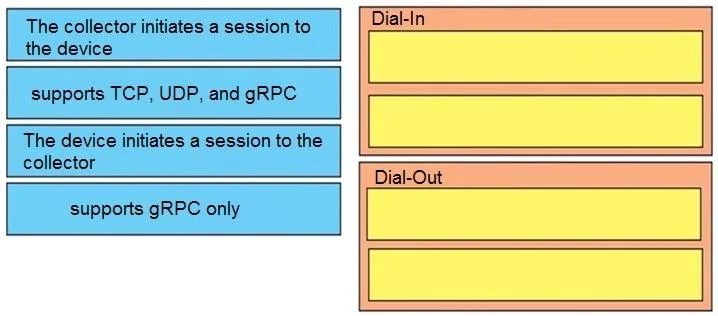
Drag and Drop Question Drag and drop the characteristics from the left onto the telemetry mode they apply to on the right. Answer:
The correct answer is The collector initiates a session to the device; supports gRPC only; The device initiates a session to the collector; supports TCP, UDP, and gRPC. This question tests understanding of network telemetry modes, Dial-In and Dial-Out, by requiring the classification of characteristics related to session initiation and supported protocols.
Question
Drag and Drop Question Drag and drop the characteristics from the left onto the telemetry mode they apply to on the right. Answer:
Exhibit
Answer Area
Drag items
Correct arrangement
- The collector initiates a session to the device
- supports gRPC only
- The device initiates a session to the collector
- supports TCP, UDP, and gRPC
Explanation
This question tests understanding of network telemetry modes, Dial-In and Dial-Out, by requiring the classification of characteristics related to session initiation and supported protocols.
Approach. To correctly answer this question, one must understand the fundamental differences between Dial-In and Dial-Out telemetry modes:
-
Dial-In Telemetry: In this mode, the data collector (management station) actively initiates a session to the network device to pull telemetry data. This is typically associated with gRPC Network Management Interface (gNMI) where gRPC (Google Remote Procedure Call) is the primary protocol for communication. Therefore, the characteristic 'The collector initiates a session to the device' and 'supports gRPC only' are correctly assigned to 'Dial-In'.
-
Dial-Out Telemetry: In this mode, the network device itself initiates a session to the data collector to push telemetry data. The device streams data to the collector using various transport protocols. While gRPC can be used for Dial-Out, the option 'supports TCP, UDP, and gRPC' indicates a broader range of commonly used transport protocols for device-initiated data streaming. Therefore, the characteristic 'The device initiates a session to the collector' and 'supports TCP, UDP, and gRPC' are correctly assigned to 'Dial-Out'.
Common mistakes.
- common_mistake. A common mistake is confusing which entity initiates the session: the collector or the device. Incorrectly associating 'The collector initiates a session to the device' with 'Dial-Out' or 'The device initiates a session to the collector' with 'Dial-In' would lead to an incorrect answer. Another mistake would be to misinterpret the protocol support. Forgetting that Dial-In (especially gNMI-based pull) often focuses on gRPC, and that Dial-Out (push) can leverage a wider range of standard transports like TCP, UDP, and gRPC, could lead to swapping the protocol characteristic boxes. For example, incorrectly placing 'supports gRPC only' under 'Dial-Out' or 'supports TCP, UDP, and gRPC' under 'Dial-In' would be wrong.
Concept tested. Network telemetry, streaming telemetry, Dial-In (pull) vs. Dial-Out (push) data models, gRPC, and various transport protocols (TCP, UDP).
Topics
Community Discussion
No community discussion yet for this question.