
300-420 · Question #149
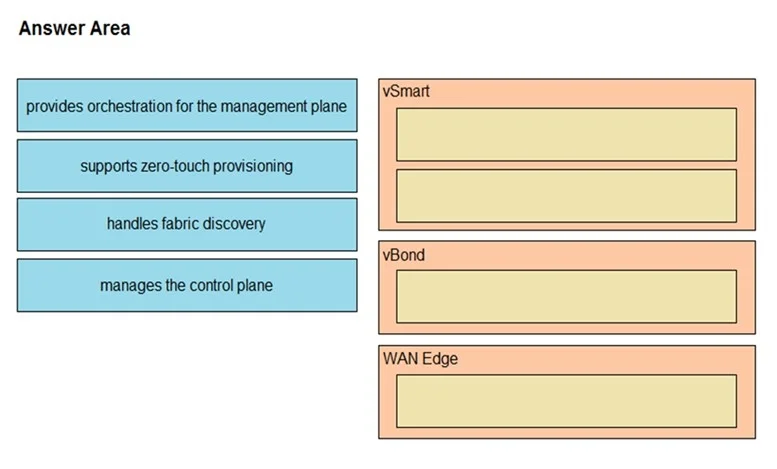
Drag and Drop Question Drag and drop the properties from the left onto the Cisco SD-WAN components that perform them on the right. Answer:
The correct answer is The collector initiates a session to the device; supports gRPC only; The device initiates a session to the collector; supports TCP, UDP, and gRPC. This drag-and-drop question tests knowledge of the core functions and roles of Cisco SD-WAN components: vSmart, vBond, and WAN Edge.
Question
Drag and Drop Question Drag and drop the properties from the left onto the Cisco SD-WAN components that perform them on the right. Answer:
Exhibit
Answer Area
Drag items
Correct arrangement
- The collector initiates a session to the device
- supports gRPC only
- The device initiates a session to the collector
- supports TCP, UDP, and gRPC
Explanation
This drag-and-drop question tests knowledge of the core functions and roles of Cisco SD-WAN components: vSmart, vBond, and WAN Edge.
Approach. The correct interaction is to drag each property to its corresponding Cisco SD-WAN component based on their defined roles:
- 'provides orchestration for the management plane' should be dragged to vBond. The vBond orchestrator is responsible for authenticating and authorizing all SD-WAN components and orchestrating the initial secure connectivity among them, which is a foundational aspect of the management plane's operation.
- 'supports zero-touch provisioning' should be dragged to WAN Edge. WAN Edge routers are the physical or virtual devices deployed at branches or data centers, and they are designed to support Zero-Touch Provisioning (ZTP) for automated onboarding into the SD-WAN fabric.
- 'handles fabric discovery' should be dragged to vSmart. The vSmart controller serves as the central control plane, responsible for building and maintaining the network topology, distributing routing information, and discovering the various components within the overlay fabric.
- 'manages the control plane' should be dragged to vSmart. The vSmart controller is the definitive control plane element in Cisco SD-WAN, establishing and maintaining secure connections to WAN Edge devices, distributing routing policies, and ensuring reachability across the overlay network.
Common mistakes.
- common_mistake. Common mistakes include confusing the distinct roles of vSmart and vBond, or misattributing the Zero-Touch Provisioning feature. For instance, incorrectly assigning 'manages the control plane' to vBond would be wrong because vBond is primarily an orchestrator for initial setup and authentication, not the ongoing manager of the control plane's routing and policy. Similarly, dragging 'supports zero-touch provisioning' to vSmart or vBond would be incorrect, as ZTP is a feature applied to the WAN Edge devices for automated deployment, not to the controllers themselves. Attributing 'handles fabric discovery' to vBond would also be a mistake, as while vBond facilitates initial introductions, vSmart actively discovers and builds the fabric topology through its control plane functions.
Concept tested. The core concept being tested is the understanding of the architectural components and their specific functions within a Cisco SD-WAN solution, specifically the roles of the vSmart controller, vBond orchestrator, and WAN Edge router.
Topics
Community Discussion
No community discussion yet for this question.