
300-420 · Question #176
An engineer uses Postman and YANG to configure a router with: - OSPF process ID 200 - network 172.16.10.128/26 enabled for Area 0 Which get-config reply verifies that the model set was designed…
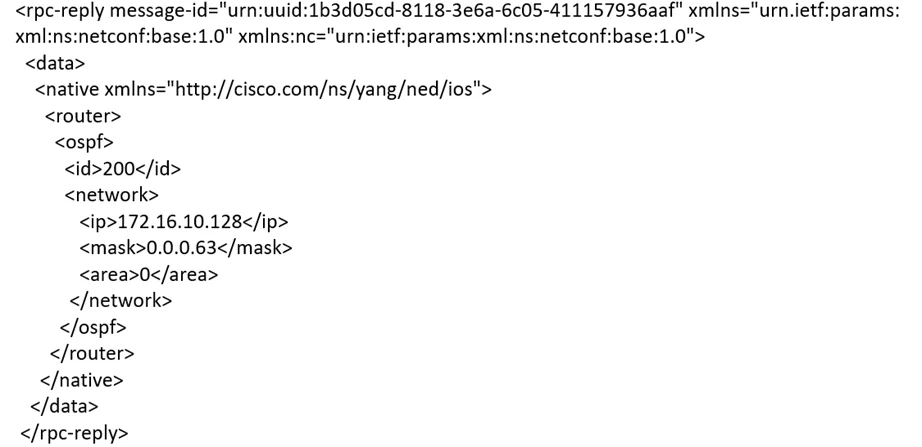
The correct answer is A. <rpc-reply message-id="urn:uuid:1b3d05cd-8118-3e6a-6c05-011157936aaf" xmlns="urn:ietf:params:xml:ns:netconf:base:1.0" xmlns:nc="urn:ietf:params:xml:ns:netconf:base:1.0"> <data> <native xmlns="http://cisco.com/ns/yang/ned/ios"> <router> <ospf> <id>200</id> <network> <ip>172.16.10.128</ip> <mask>0.0.0.63</mask> <area>0</area> </network> </ospf> </router> </native> </data> </rpc-reply>. This question tests the understanding of OSPF network command configuration within a YANG/NETCONF XML structure, specifically focusing on the correct wildcard mask for a given prefix length.
Question
An engineer uses Postman and YANG to configure a router with:
- OSPF process ID 200
- network 172.16.10.128/26 enabled for Area 0
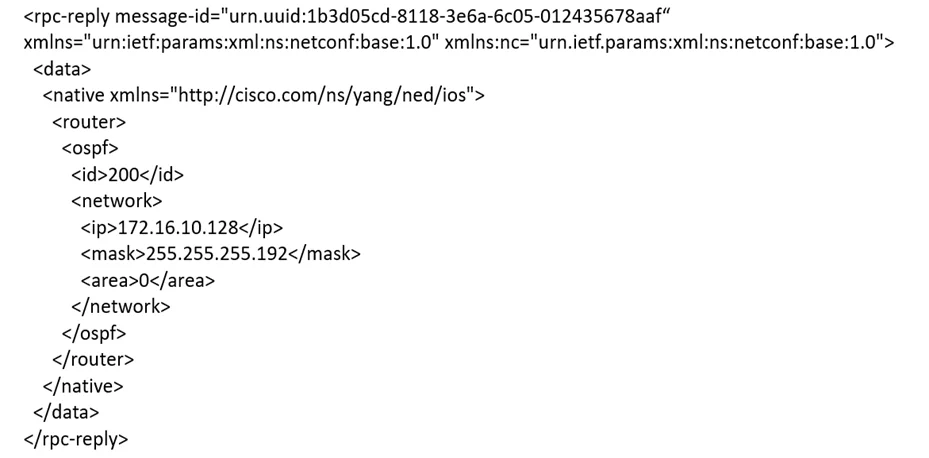
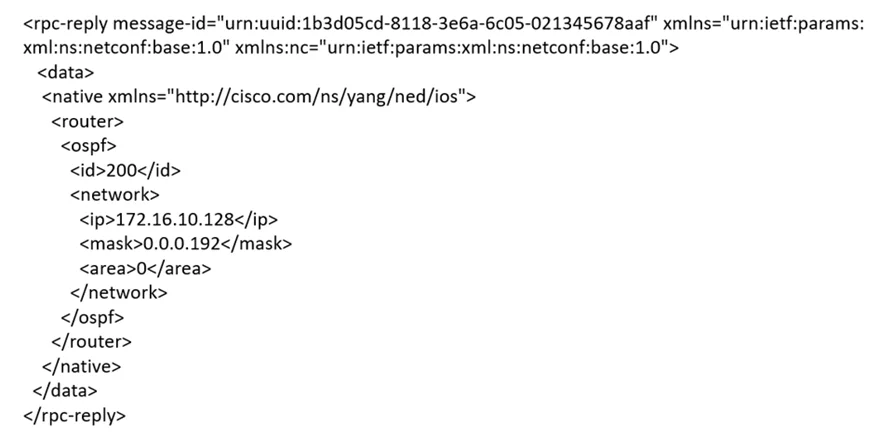
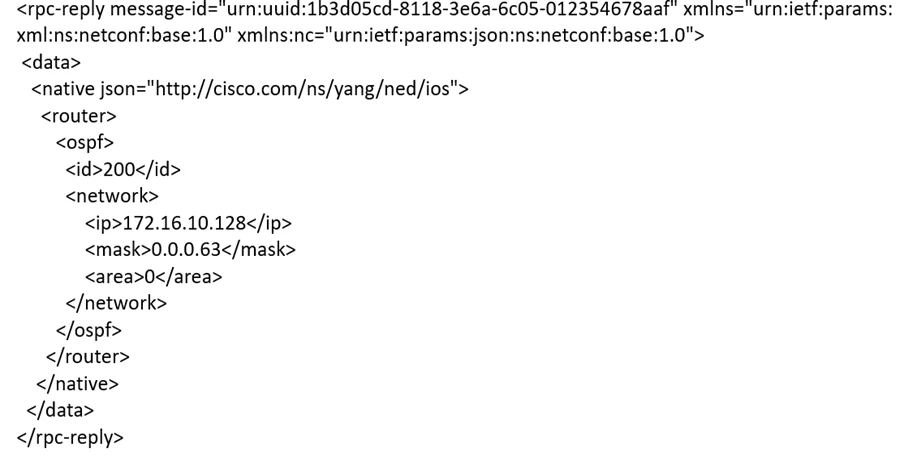
Which get-config reply verifies that the model set was designed correctly? A. B. C. D.
Exhibits
Options
- A<rpc-reply message-id="urn:uuid:1b3d05cd-8118-3e6a-6c05-011157936aaf" xmlns="urn:ietf:params:xml:ns:netconf:base:1.0" xmlns:nc="urn:ietf:params:xml:ns:netconf:base:1.0"> <data> <native xmlns="http://cisco.com/ns/yang/ned/ios"> <router> <ospf> <id>200</id> <network> <ip>172.16.10.128</ip> <mask>0.0.0.63</mask> <area>0</area> </network> </ospf> </router> </native> </data> </rpc-reply>
- B<rpc-reply message-id="urn:uuid:1b3d05cd-8118-3e6a-6c05-012435678aaf" xmlns="urn:ietf:params:xml:ns:netconf:base:1.0" xmlns:nc="urn:ietf:params:xml:ns:netconf:base:1.0"> <data> <native xmlns="http://cisco.com/ns/yang/ned/ios"> <router> <ospf> <id>200</id> <network> <ip>172.16.10.128</ip> <mask>255.255.255.192</mask> <area>0</area> </network> </ospf> </router> </native> </data> </rpc-reply>
- C<rpc-reply message-id="urn:uuid:1b3d05cd-8118-3e6a-6c05-021345678aaf" xmlns="urn:ietf:params:xml:ns:netconf:base:1.0" xmlns:nc="urn:ietf:params:xml:ns:netconf:base:1.0"> <data> <native xmlns="http://cisco.com/ns/yang/ned/ios"> <router> <ospf> <id>200</id> <network> <ip>172.16.10.128</ip> <mask>0.0.0.192</mask> <area>0</area> </network> </ospf> </router> </native> </data> </rpc-reply>
- D<rpc-reply message-id="urn:uuid:1b3d05cd-8118-3e6a-6c05-012354678aaf" xmlns="urn:ietf:params:xml:ns:netconf:base:1.0" xmlns:nc="urn:ietf:params:xml:ns:netconf:base:1.0"> <data> <native xmlns="http://cisco.com/ns/yang/ned/ios"> <router> <ospf> <id>200</id> <network> <ip>172.16.10.128</ip> <mask>0.0.0.63</mask> <area>0</area> </network> </ospf> </router> </native> </data> </rpc-reply>
How the community answered
(21 responses)- A81% (17)
- B10% (2)
- C5% (1)
- D5% (1)
Why each option
This question tests the understanding of OSPF network command configuration within a YANG/NETCONF XML structure, specifically focusing on the correct wildcard mask for a given prefix length.
For OSPF network configuration in Cisco IOS devices, the `network` command uses a wildcard mask, which is the inverse of the subnet mask. A /26 prefix corresponds to a subnet mask of 255.255.255.192, and its inverse, the wildcard mask, is 0.0.0.63. Option A correctly represents this wildcard mask in the `get-config` reply.
Option B uses a standard subnet mask (255.255.255.192) instead of the required OSPF wildcard mask, which is incorrect for this configuration context.
Option C presents an incorrect wildcard mask (0.0.0.192) for a /26 network; the correct wildcard mask is 0.0.0.63.
Option D provides the same correct wildcard mask as option A, which might indicate a duplication or minor variation in a real exam, but its content is functionally correct based on the requirements.
Concept tested: OSPF network wildcard mask in YANG/NETCONF
Source: https://www.cisco.com/c/en/us/td/docs/ios-xml/ios/iproute_ospf/configuration/15-mt/iro-15-mt-cr-book/iro-ospf-cfg-ospf.html
Topics
Community Discussion
No community discussion yet for this question.