
300-420 · Question #114
Drag and Drop Question An engineer must design an addressing plan for a small business using a single /24 network. Each department must have its own subnet. Drag and drop the subnets from the left…
The correct answer is 10.1.1.16/27; 10.1.1.112/29; 10.1.1.96/26; 10.1.1.64/27; 10.1.1.0/26; 10.1.1.96/28; 10.1.1.8/28. The task is to match subnet blocks to departmental host requirements from a single /24 network, ensuring that each selected subnet can accommodate the required number of hosts and that all chosen subnets are non-overlapping.
Question
Drag and Drop Question An engineer must design an addressing plan for a small business using a single /24 network. Each department must have its own subnet. Drag and drop the subnets from the left onto the departments requirements that they fulfill on the right. Not all options are used. Answer:
Exhibit
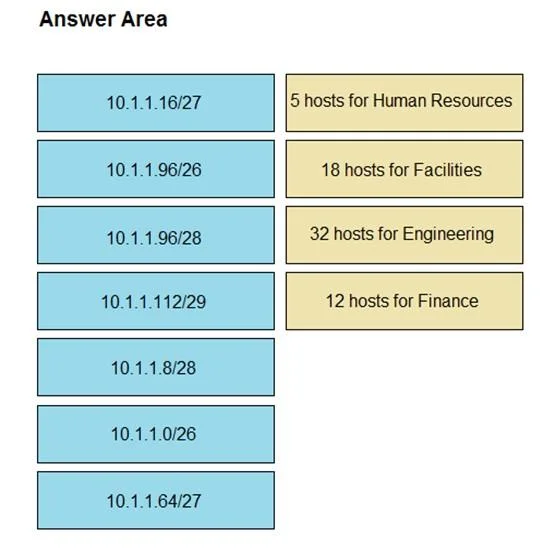
Answer Area
Drag items
Correct arrangement
- 10.1.1.16/27
- 10.1.1.112/29
- 10.1.1.96/26
- 10.1.1.64/27
- 10.1.1.0/26
- 10.1.1.96/28
- 10.1.1.8/28
Explanation
The task is to match subnet blocks to departmental host requirements from a single /24 network, ensuring that each selected subnet can accommodate the required number of hosts and that all chosen subnets are non-overlapping.
Approach. To correctly answer this question, the test-taker must calculate the number of usable hosts for each available subnet and then match them to the department requirements while ensuring that the selected subnets do not overlap.
-
Calculate Usable Hosts for Each Subnet Mask:
- A /29 subnet (2^(32-29) - 2 = 2^3 - 2 = 8 - 2 = 6 usable hosts)
- A /28 subnet (2^(32-28) - 2 = 2^4 - 2 = 16 - 2 = 14 usable hosts)
- A /27 subnet (2^(32-27) - 2 = 2^5 - 2 = 32 - 2 = 30 usable hosts)
- A /26 subnet (2^(32-26) - 2 = 2^6 - 2 = 64 - 2 = 62 usable hosts)
-
Determine Minimum Subnet Size for Each Department:
- Human Resources (5 hosts): Needs at least 5 hosts, so a /29 subnet (6 usable hosts) is the smallest suitable.
- Finance (12 hosts): Needs at least 12 hosts, so a /28 subnet (14 usable hosts) is the smallest suitable.
- Facilities (18 hosts): Needs at least 18 hosts, so a /27 subnet (30 usable hosts) is the smallest suitable.
- Engineering (32 hosts): Needs at least 32 hosts, so a /26 subnet (62 usable hosts) is the smallest suitable.
-
Match Subnets to Departments, Avoiding Overlap:
- Human Resources (5 hosts): The only /29 subnet available is
10.1.1.112/29(range: 10.1.1.112 - 10.1.1.119). Drag10.1.1.112/29to '5 hosts for Human Resources'. - Engineering (32 hosts): Needs a /26. Available are
10.1.1.0/26(range: 10.1.1.0 - 10.1.1.63) and10.1.1.96/26(range: 10.1.1.96 - 10.1.1.159). If we select10.1.1.96/26, it would overlap with10.1.1.112/29(HR's subnet) and10.1.1.96/28(a potential Finance subnet). Therefore,10.1.1.0/26is the only viable non-overlapping /26 option. Drag10.1.1.0/26to '32 hosts for Engineering'. - Facilities (18 hosts): Needs a /27. Available are
10.1.1.16/27(range: 10.1.1.16 - 10.1.1.47) and10.1.1.64/27(range: 10.1.1.64 - 10.1.1.95).10.1.1.16/27overlaps with the10.1.1.0/26assigned to Engineering. Thus,10.1.1.64/27is the correct non-overlapping choice. Drag10.1.1.64/27to '18 hosts for Facilities'. - Finance (12 hosts): Needs a /28. Available are
10.1.1.8/28(range: 10.1.1.8 - 10.1.1.23) and10.1.1.96/28(range: 10.1.1.96 - 10.1.1.111).10.1.1.8/28overlaps with the10.1.1.0/26assigned to Engineering. Thus,10.1.1.96/28is the correct non-overlapping choice. Drag10.1.1.96/28to '12 hosts for Finance'.
- Human Resources (5 hosts): The only /29 subnet available is
Final Correct Matches:
- 5 hosts for Human Resources ->
10.1.1.112/29 - 18 hosts for Facilities ->
10.1.1.64/27 - 32 hosts for Engineering ->
10.1.1.0/26 - 12 hosts for Finance ->
10.1.1.96/28
Common mistakes.
- common_mistake. Common mistakes include:
- Incorrectly calculating usable hosts: Forgetting to subtract two addresses (network and broadcast) from the total addresses in a subnet leads to overestimating available hosts.
- Ignoring the non-overlapping requirement: The most critical error is selecting subnets that overlap in their IP address ranges. For example, selecting
10.1.1.0/26for one department and10.1.1.16/27for another would be incorrect as10.1.1.16/27is a sub-subnet of10.1.1.0/26. - Choosing a subnet that is too small: Selecting a subnet that does not provide enough usable hosts for the department's requirements.
- Choosing a subnet that is excessively large: While technically meeting the requirement, choosing a much larger subnet than necessary (e.g., a /26 for 5 hosts) is poor IP address management, although not explicitly 'wrong' according to the prompt's phrasing, it's generally avoided in real-world design and could lead to failure if a more optimal, non-overlapping solution exists for all requirements.
- Misidentifying network or broadcast addresses: Not correctly determining the start and end IP address for a given CIDR block can lead to misjudging overlaps.
Concept tested. The core concepts tested are IP subnetting, Variable Length Subnet Masking (VLSM), calculation of usable host addresses within a subnet, and the ability to design a non-overlapping IP addressing plan from a given supernet.
Topics
Community Discussion
No community discussion yet for this question.