
300-420 · Question #113
Refer to the exhibit. An architect must design a solution to connect the network behind R3 with the EIGRP network. Which mechanism should be included to avoid routing loops?
The correct answer is C. route tags. To prevent routing loops when connecting a network behind R3 with an EIGRP network, especially during route redistribution, route tags should be used.
Question
Refer to the exhibit. An architect must design a solution to connect the network behind R3 with the EIGRP network. Which mechanism should be included to avoid routing loops?
Exhibit
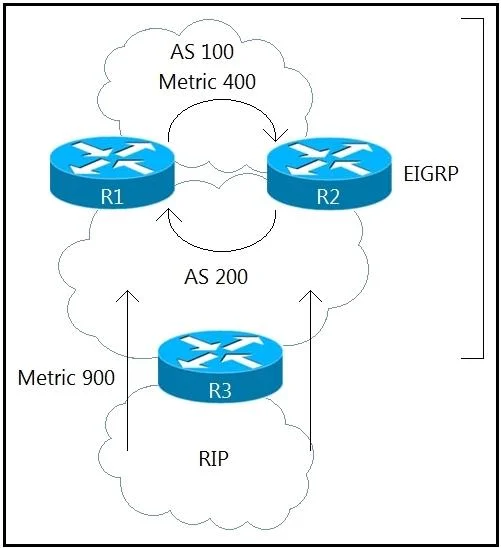
Options
- Adown bit
- Bsplit horizon
- Croute tags
- Dsummarization
How the community answered
(27 responses)- A11% (3)
- B4% (1)
- C81% (22)
- D4% (1)
Why each option
To prevent routing loops when connecting a network behind R3 with an EIGRP network, especially during route redistribution, route tags should be used.
The 'down bit' is a specific OSPF mechanism for inter-area route summarization loop prevention, not a general EIGRP redistribution loop prevention mechanism.
Split horizon is an internal loop prevention mechanism within distance-vector protocols like EIGRP, preventing routes from being advertised back out the interface they were learned on, and does not address redistribution loops.
Route tags are custom identifiers attached to routes when they are redistributed between different routing protocols. EIGRP can then be configured with route maps to filter incoming routes based on these tags, preventing a route from being re-injected into its original protocol domain after redistribution, thus avoiding loops.
Summarization aggregates routes to reduce table size and improve stability, but it is not a direct mechanism for preventing routing loops during redistribution between different routing protocols.
Concept tested: Routing protocol redistribution, EIGRP loop prevention, route tagging
Source: https://www.cisco.com/c/en/us/support/docs/ip/enhanced-interior-gateway-routing-protocol-eigrp/16406-redistribution.html
Topics
Community Discussion
No community discussion yet for this question.