
PMP · Question #384
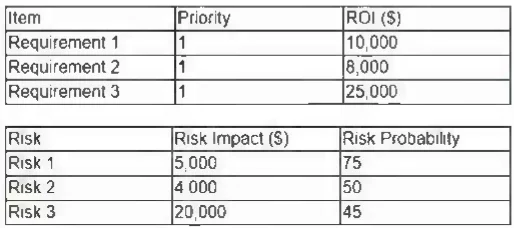
The tables show the requirements for an agile project with the anticipated return on investment (ROI) and identified project risks, along with the analysis details. \ What should be the priority…
The correct answer is D. Requirement 3, Requirement 1, Risk 3, Requirement 2, Risk 1, Risk 2. In agile projects, backlog prioritization balances delivering high-value requirements with mitigating critical risks early. The optimal order sequences high ROI items, then critical risks, followed by other requirements and remaining risks.
Question
Exhibit
Options
- ARisk 3, Risk 1, Risk 2, Requirement 3, Requirement 1, Requirement 2
- BRequirement 3, Risk 3, Requirement 1, Requirement 2, Risk 2
- CRequirement 3, Requirement 1, Requirement 2
- DRequirement 3, Requirement 1, Risk 3, Requirement 2, Risk 1, Risk 2
How the community answered
(27 responses)- A7% (2)
- B4% (1)
- C15% (4)
- D74% (20)
Why each option
In agile projects, backlog prioritization balances delivering high-value requirements with mitigating critical risks early. The optimal order sequences high ROI items, then critical risks, followed by other requirements and remaining risks.
Prioritizing all risks before any requirements is generally incorrect as agile focuses on delivering value iteratively and early.
This order mixes items but may not follow an optimal balance of ROI and risk criticality, potentially delaying high-value delivery or critical risk mitigation.
Prioritizing only requirements without considering significant risks early is a common pitfall in agile, ignoring the importance of de-risking the project.
Agile backlog prioritization considers both business value (ROI) and risk. The order (Requirement 3, Requirement 1, Risk 3, Requirement 2, Risk 1, Risk 2) suggests prioritizing the highest ROI requirements first, then addressing a critical risk that warrants early mitigation, before lower ROI requirements and other risks in a balanced sequence.
Concept tested: Agile backlog prioritization (Value & Risk)
Source: https://learn.microsoft.com/en-us/azure/devops/boards/backlogs/organize-backlog?view=azure-devops
Topics
Community Discussion
9 Luis F.Jul 5, 2026
D is the correct answer here. In agile you prioritize by value and ROI first, which puts Requirement 3 at the top followed by Requirement 1 and then Requirement 2. Risk 3 gets slotted in after Requirement 1 because it has a solid ROI and addresses a high priority risk early without pushing the top value items down too far. I almost picked A because I thought risks should always come first, but the product owner ranks everything by business value, risks do not automatically jump the line.
 Olusegun A.Jul 6, 2026
Agree on value-driven ordering but the product owner ranks by business value, not ROI - those are not the same thing and the exam will trap you on that distinction.
 Nina C.Jul 5, 2026
Going with D. C looks clean but ignores that risks still need priority ordering.
 Fatima Z.Jul 8, 2026
Right on, D is the answer, and remember the priority ordering piece with my little hook R-P-R: Rank risks first, Prioritize actions second, Respond accordingly, because a clean looking risk register with no ranking is just a fancy list of worries.
Fatima Z.Jul 5, 2026D is correct here and the mnemonic I use is R.O.I. equals Rank Order Immediately. You stack the highest value items first, so Requirement 3, then Requirement 1, and you slot Risk 3 right after because it is the highest priority risk that needs early attention. Then you finish with Requirement 2 and the remaining risks, giving you the exact D sequence. Does anyone know if the PMI exam always expects risks to be interleaved with requirements like this, or would they ever group all the risks separately at the bottom?
 Hiroshi T.Jul 8, 2026
D is right for the sequence but PMI does not prescribe interleaving risks with requirements at all; per the PMBOK Guide, risks are prioritized through Perform Qualitative Risk Analysis using probability and impact, and that ranking feeds the risk register independently of the requirements prioritization, so how you present them together is a stakeholder communication choice, not a defined process.
Olusegun A.Jul 3, 2026D is correct. You prioritize by ROI first but sequence Risk 3 early since it likely affects Requirement 1, while lower-value risks get deferred.
Nina C.Jul 4, 2026Agreed on D, and the way you phrased it helps me see the difference between prioritizing by ROI and sequencing by dependency, which is where I keep tripping up.
Hiroshi T.Jul 5, 2026D is correct. Agile prioritization weights ROI value and risk probability and impact together.