
PL-500 · Question #95
Drag and Drop Question A user is evaluating the capabilities of both process mining and task mining. You need to determine when you should use process mining or task mining. Which Process advisor…
The correct answer is Process mining; Process mining; Task mining; Task mining. This question tests the ability to differentiate between Process Mining and Task Mining capabilities within Process Advisor and apply them to specific business requirements.
Question
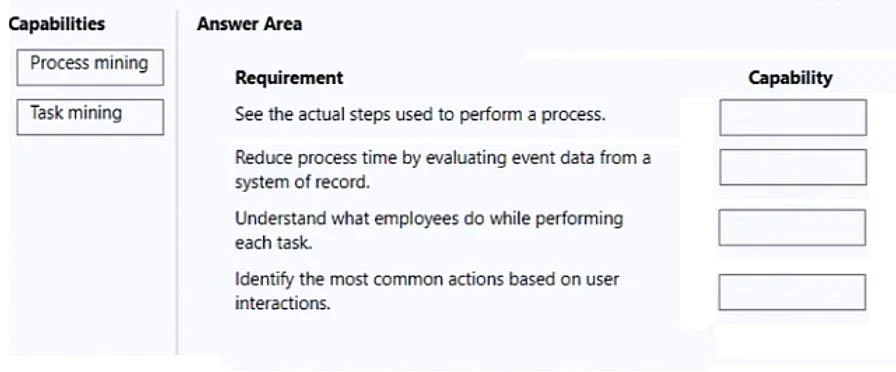
Drag and Drop Question A user is evaluating the capabilities of both process mining and task mining. You need to determine when you should use process mining or task mining. Which Process advisor capability should you use? To answer, drag the appropriate capabilities to the correct requirements. Each capability may be used once, more than once, or not at all. You may need to drag the split bar between panes or scroll to view content. NOTE: Each correct selection is worth one point. Answer:
Exhibit
Answer Area
Drag items
Correct arrangement
- Process mining
- Process mining
- Task mining
- Task mining
Explanation
This question tests the ability to differentiate between Process Mining and Task Mining capabilities within Process Advisor and apply them to specific business requirements.
Approach. The correct interaction is to drag 'Process mining' to the first two requirements and 'Task mining' to the last two. Here's the reasoning for each match:
-
Requirement: See the actual steps used to perform a process.
- Capability: Process mining. Process mining discovers, monitors, and improves actual processes by analyzing event logs from systems of record. It provides a visual map of the end-to-end process flow, showing all variations and steps.
-
Requirement: Reduce process time by evaluating event data from a system of record.
- Capability: Process mining. Process mining analyzes event data from enterprise systems (like ERP, CRM) to identify bottlenecks, deviations, and inefficiencies in a process, with the primary goal of optimizing the entire process for better performance, including reducing time.
-
Requirement: Understand what employees do while performing each task.
- Capability: Task mining. Task mining focuses on the individual user's desktop interactions. It records mouse clicks, keyboard inputs, and application usage to understand the exact steps and variations employees take when performing a specific task.
-
Requirement: Identify the most common actions based on user interactions.
- Capability: Task mining. Task mining's core function is to analyze granular user interactions (clicks, keystrokes) to identify patterns, common actions, and variations in how users complete a task, often to standardize or automate parts of it.
Common mistakes.
- common_mistake. A common mistake is confusing the scope of Process Mining and Task Mining. Process mining operates at a macro, end-to-end business process level, using aggregated system event data to understand the overall flow and performance. Task mining operates at a micro, individual user desktop level, using user interaction data to understand how specific tasks are performed. Incorrectly matching requirements like 'See the actual steps used to perform a process' (a macro view) with Task mining, or 'Understand what employees do while performing each task' (a micro view of user behavior) with Process mining would be wrong because it misinterprets their fundamental data sources and analytical focus. For instance, using Task mining for 'reducing process time by evaluating event data from a system of record' would be incorrect because Task mining focuses on user-level task execution, not holistic process optimization from system logs.
Concept tested. The core concept being tested is the understanding of the distinct capabilities and applications of Process Mining versus Task Mining within a process intelligence framework, specifically in the context of Microsoft Power Automate Process Advisor.
Topics
Community Discussion
No community discussion yet for this question.