
PL-200 · Question #104
Drag and Drop Question You are designing an app for a bank. You must create entities for the app and configure relationships between entities: Which relationship types should you use? To answer…
The correct answer is N: 1; N: N; N: 1. This question tests the understanding of entity relationship types (1:N, N:N, N:1) in the context of designing an application for a bank, specifically within platforms like Microsoft Dataverse or Dynamics 365.
Question
Exhibit
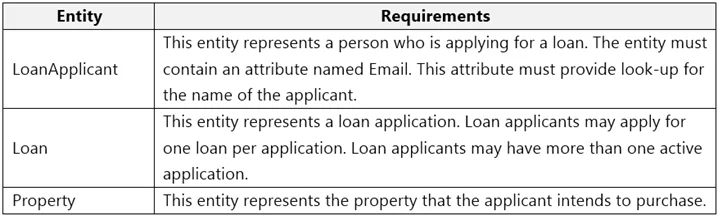
Answer Area
Drag items
Correct arrangement
- N: 1
- N: N
- N: 1
Explanation
This question tests the understanding of entity relationship types (1:N, N:N, N:1) in the context of designing an application for a bank, specifically within platforms like Microsoft Dataverse or Dynamics 365.
Approach. The correct approach involves analyzing each requirement to determine the cardinality of the relationship between the implied entities.
-
Requirement 1: 'The email attribute of the Loan Applicant entity must provide a look-up to the contact name and email.'
- This describes a lookup field. In Dataverse (and similar systems), a lookup field on an entity (e.g.,
LoanApplicant) that points to another entity (e.g., aContactor masterEmailrecord) represents a Many-to-One (N:1) relationship. ManyLoanApplicantrecords (N) can refer to a singleContactorEmailMasterrecord (1). - Correct selection: N : 1
- This describes a lookup field. In Dataverse (and similar systems), a lookup field on an entity (e.g.,
-
Requirement 2: 'Loan applicants can apply for one type of loan per application. Applicants can have more than one application.'
- Let's analyze the relationship between
LoanApplicantandLoanentities. - 'Applicants can have more than one application': This indicates that one
LoanApplicant(1) can be associated with manyLoanapplications (N). - 'Loan applicants can apply for one type of loan per application': This sentence, especially if 'Loan applicants' is interpreted as plural in the context of a single application, suggests that a single
Loanapplication could potentially involve multipleLoanApplicants (e.g., co-applicants). If oneLoan(N) can have manyLoanApplicants (N), combined with the previous point, it forms a Many-to-Many (N:N) relationship betweenLoanApplicantandLoan. - Correct selection: N : N
- Let's analyze the relationship between
-
Requirement 3: 'Loans must be applied for for a single property.'
- This describes the relationship between the
Loanentity and thePropertyentity. - 'Loans must be applied for for a single property': This means that one
Loanapplication (N) is associated with only oneProperty(1). - Conversely, a single
Propertycan be associated with multipleLoanapplications (e.g., refinancing, different applicants for the same property). Therefore, manyLoans (N) relate to oneProperty(1). - Correct selection: N : 1
- This describes the relationship between the
Common mistakes.
- common_mistake. A common mistake is misinterpreting the direction or cardinality of the relationship. For example:
- Confusing 1:N with N:1: For 'Loans must be applied for for a single property', selecting '1:N' would imply one
Loancan be for manyPropertys, which contradicts the requirement. Similarly, for the email lookup, selecting '1:N' would imply oneLoanApplicanthas many email lookup records, which is not how lookups typically function to a single master record. - Misinterpreting N:N: For 'Loan applicants and applications', some might assume a simple '1:N' (one applicant, many loans). However, the phrasing 'Loan applicants can apply for one type of loan per application' hints at the possibility of multiple applicants per loan application, leading to an N:N relationship when combined with an applicant having multiple applications.
- Ignoring lookup field implications: For the first requirement, some might overlook that a lookup field itself implies an N:1 relationship from the referencing entity (many) to the referenced entity (one).
Concept tested. Entity Relationship Modeling (ERM), specifically understanding one-to-many (1:N), many-to-one (N:1), and many-to-many (N:N) relationship types and their application in data modeling for business applications, often in the context of platforms like Microsoft Dataverse or Dynamics 365.
Topics
Community Discussion
No community discussion yet for this question.