
PL-100 · Question #212
Drag and Drop Question A company has 500 products. Each product is referenced by a product ID. Each product belongs to one of eight product categories. You are creating an app to manage requests for…
The correct answer is Data source; Table; Column; Row. This question assesses the ability to select appropriate Dataverse column data types (Choice, Text, Lookup) based on specific business requirements for data integrity and relationships.
Question
Exhibit
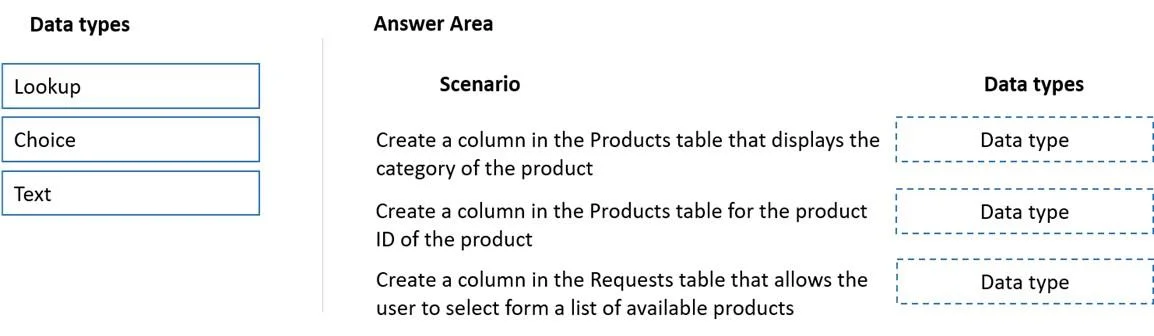
Answer Area
Drag items
Correct arrangement
- Data source
- Table
- Column
- Row
Explanation
This question assesses the ability to select appropriate Dataverse column data types (Choice, Text, Lookup) based on specific business requirements for data integrity and relationships.
Approach. 1. For 'Create a column in the Products table that displays the category of the product': The scenario states there are eight product categories, they will never change, are defined in the column itself (not a separate table), and data must not allow misspellings. The 'Choice' data type (also known as an Option Set or Picklist) is perfect for this. It defines a fixed set of options directly within the column's definition, preventing misspellings and ensuring data consistency without needing a separate lookup table. 2. For 'Create a column in the Products table for the product ID of the product': Product IDs are typically unique identifiers, often alphanumeric strings. The 'Text' data type is suitable for storing such identifiers when they are not the primary key (which Dataverse automatically handles with a GUID) and do not require a predefined list of options or a lookup to another record. It provides flexibility for various ID formats. 3. For 'Create a column in the Requests table that allows the user to select from a list of available products': This requirement explicitly states selecting from a 'list of available products', which means referencing records from the 'Products' table. The 'Lookup' data type is designed precisely for this purpose-to establish a relationship between two tables, allowing a record in one table (Requests) to reference a record in another table (Products).
Common mistakes.
- common_mistake. A common mistake for the product category column would be using 'Text', which allows for misspellings and defeats the purpose of fixed categories. Using 'Lookup' for categories would be incorrect because the scenario explicitly states categories are 'defined in the column itself, not in a separate table'. For the product ID, using 'Choice' would be impractical as it's not a small, fixed set of options like categories. For selecting from a list of available products, using 'Text' would allow free-form input, losing data integrity and the ability to link to actual product records, while 'Choice' wouldn't allow referencing records from another table.
Concept tested. Microsoft Dataverse data types, specifically understanding the use cases for Choice (Option Set/Picklist), Text, and Lookup columns, and how to apply them to ensure data integrity, prevent misspellings, and establish relationships between tables.
Topics
Community Discussion
No community discussion yet for this question.