
PFMP · Question #227
A portfolio manager who is developing a probability and impact matrix for a portfolio receives the following data and decides that everything with a score over 0.2 should be highlighted and…
The correct answer is C. Exclude Threat 3 from the matrix. A probability of 1.0 means the event is certain to occur - it is no longer a risk (an uncertain future event) but rather a known issue or constraint. Risk management deals with uncertain events; once probability reaches 1.0, the event is certain and should be treated as an…
Question
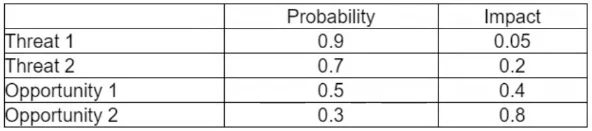
A portfolio manager who is developing a probability and impact matrix for a portfolio receives the following data and decides that everything with a score over 0.2 should be highlighted and addressed. The portfolio manager finds a new threat – Threat 3 – with a probability of 1.0 and an impact of 0.4. Which action should the portfolio manager take?
Exhibit
Options
- AReevaluate Threats 1 and 2 in the context of Threat 3.
- BReevaluate Opportunities 1 and 2 in the context of Threat 3.
- CExclude Threat 3 from the matrix.
- DDevelop a risk response to Threat 3.
How the community answered
(35 responses)- A6% (2)
- B3% (1)
- C77% (27)
- D14% (5)
Explanation
A probability of 1.0 means the event is certain to occur - it is no longer a risk (an uncertain future event) but rather a known issue or constraint. Risk management deals with uncertain events; once probability reaches 1.0, the event is certain and should be treated as an issue and managed through issue management processes, not the risk register or probability-impact matrix. Including it in a risk matrix would be methodologically incorrect. Although its score (1.0 × 0.4 = 0.4) exceeds the 0.2 threshold, the nature of the item disqualifies it from the risk matrix. Developing a risk response (D) is appropriate for uncertain risks, not certainties. Reevaluating other threats in its context (A, B) is not warranted by this finding alone.
Topics
Community Discussion
No community discussion yet for this question.