
MS-900 · Question #442
Hotspot Question A company is investigating the service-level agreements (SLAs) provided by Microsoft 365. For each of the following statements, select Yes if the statement is true. Otherwise…
The correct answer is The SLA describes the Microsoft uptime commitments for Microsoft Online Services. = Yes; The SLA describes the Microsoft connectivity commitments for Microsoft Online Services. = Yes; The SLA describes the support options available to managed service providers. = No. The correct approach is to select 'Yes' for statements regarding uptime and connectivity commitments in a Microsoft Online Services SLA, and 'No' for a statement about support options for managed service providers, as the latter falls outside the primary scope of an SLA.
Question
Exhibit
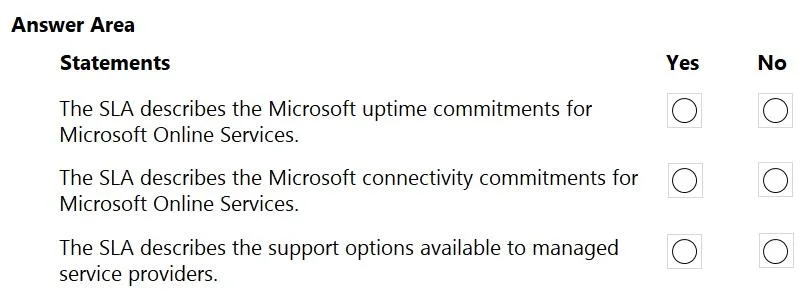
Answer Area
- The SLA describes the Microsoft uptime commitments for Microsoft Online Services.Yes
- The SLA describes the Microsoft connectivity commitments for Microsoft Online Services.Yes
- The SLA describes the support options available to managed service providers.No
Explanation
The correct approach is to select 'Yes' for statements regarding uptime and connectivity commitments in a Microsoft Online Services SLA, and 'No' for a statement about support options for managed service providers, as the latter falls outside the primary scope of an SLA.
Approach. The test-taker must click the 'Yes' radio button for the first statement, the 'Yes' radio button for the second statement, and the 'No' radio button for the third statement.
-
Statement 1: 'The SLA describes the Microsoft uptime commitments for Microsoft Online Services.' - Select 'Yes'. Service Level Agreements (SLAs) are primarily designed to define the availability and performance guarantees of a service. Uptime commitments (e.g., 99.9% availability) are a fundamental component of virtually all cloud service SLAs, including those for Microsoft Online Services. If these commitments are not met, customers are typically eligible for service credits.
-
Statement 2: 'The SLA describes the Microsoft connectivity commitments for Microsoft Online Services.' - Select 'Yes'. While related to uptime, connectivity is a distinct aspect often covered in SLAs. For online services, connectivity commitments ensure that not only is the service 'up,' but it is also reachable and accessible over the network. This includes guarantees around network availability and performance, which directly impact the user experience and service accessibility.
-
Statement 3: 'The SLA describes the support options available to managed service providers.' - Select 'No'. An SLA's core purpose is to define service performance, availability, and the remedies (like service credits) if those targets are not met. While an SLA might mention general incident reporting procedures or customer support channels related to an SLA breach, it does not typically detail the full range of 'support options available to managed service providers.' Support plans, specific partner programs, and detailed escalation paths for MSPs are usually covered under separate agreements, such as Microsoft Partner Network agreements or specific support contracts, not the general service-level agreement for the online service itself.
Common mistakes.
- common_mistake. A common mistake would be to select 'No' for uptime or connectivity commitments. These are core components of any robust cloud service SLA, and misunderstanding their inclusion indicates a lack of fundamental knowledge about SLAs. Another mistake would be to select 'Yes' for the statement about support options for managed service providers. This reflects a misunderstanding of the scope of a standard SLA, which focuses on service performance and availability for the customer, not specific support offerings for third-party providers, which are typically governed by separate commercial or partnership agreements.
Concept tested. Understanding of Service Level Agreements (SLAs) for Microsoft Online Services, including their purpose, scope, and key components (uptime, connectivity, and performance guarantees versus support options).
Topics
Community Discussion
No community discussion yet for this question.