MB-800 · Question #93
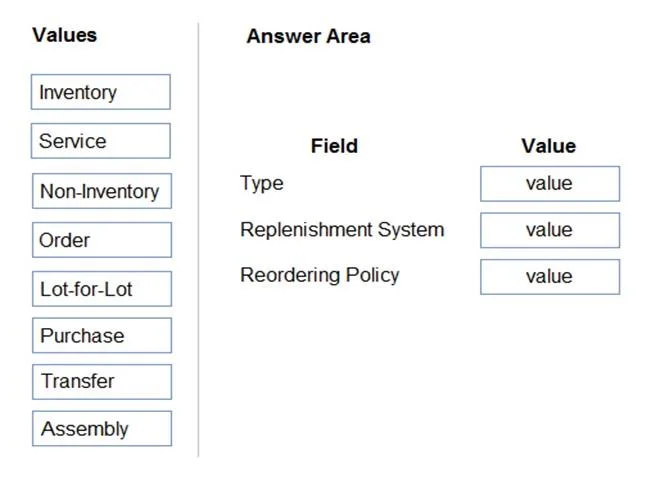
Drag and Drop Question You are setting up a new item in Dynamics 365 Business Central. The item is a tangible good with an inventory asset value. The item is acquired by purchase specifically for…
The correct answer is Inventory; Purchase; Order. Dynamics 365 Business Central - Item Card Configuration Scenario recap: A tangible good, tracked in inventory, purchased on-demand per sales order. --- Field 1: Type → Inventory BC offers three item types: Inventory - physical, tangible goods tracked with stock levels and…
Question
Exhibit
Answer Area
Drag items
Correct arrangement
- Inventory
- Purchase
- Order
Explanation
Dynamics 365 Business Central - Item Card Configuration
Scenario recap: A tangible good, tracked in inventory, purchased on-demand per sales order.
Field 1: Type → Inventory
BC offers three item types:
- Inventory - physical, tangible goods tracked with stock levels and valuation
- Non-Inventory - physical goods not tracked in stock (e.g., consumables, drop-shipped items you don't count)
- Service - labor, services, or non-physical offerings
The requirement says tangible good with an inventory asset value, which maps directly to Inventory. This enables bin tracking, costing, and inventory ledger entries.
Common mistake: Choosing Non-Inventory for physical items. Non-Inventory skips stock tracking, so you'd have no inventory asset value - contradicting the requirement.
Field 2: Replenishment System → Purchase
This controls how stock is replenished:
- Purchase - stock arrives via a purchase order from a vendor
- Assembly - built from component items via an assembly order
- Transfer - moved from another location
The requirement says acquired by purchase - so Purchase is the only correct choice.
Common mistake: Selecting Assembly when the item is manufactured/built, but this item is explicitly bought from a supplier.
Field 3: Reordering Policy → Order
This controls when and how much to replenish:
- Order - creates exactly one purchase order per demand, one-to-one linkage
- Lot-for-Lot - batches multiple demands into one order within a time window
- Fixed Reorder Qty / Max Qty - stock-based triggers, not demand-driven
The requirement says purchased specifically for each new instance of demand - pure make/buy-to-order behavior. Order policy creates a dedicated purchase order for each individual demand (sales order line), maintaining a hard link between supply and demand.
Common mistake: Choosing Lot-for-Lot, which also avoids excess stock but consolidates multiple demands into one order. That breaks the "specifically for each new instance" requirement, since multiple demand lines get bundled together.
Summary Table
| Field | Value | Key Reason |
|---|---|---|
| Type | Inventory | Tangible + inventory asset value |
| Replenishment System | Purchase | Acquired by purchase from vendor |
| Reordering Policy | Order | One purchase per individual demand instance |
Topics
Community Discussion
No community discussion yet for this question.