
MB-800 · Question #257
Drag and Drop Question A client uses Dynamics 365 Business Central. The client must create a manufacturing company and a sales company in Business Central. Each company must be a separate legal…
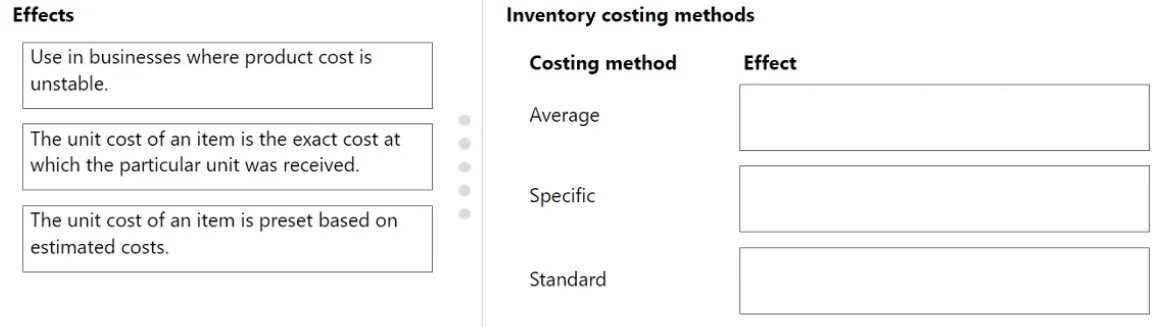
The correct answer is Use in businesses where product cost is unstable.; The unit cost of an item is the exact cost at which the particular unit was received.; The unit cost of an item is preset based on estimated costs. Business Central Costing Methods - Drag-and-Drop Explained The question is asking you to match each effect to the correct costing method. The three costing methods implied by the arrangement are Average, Specific, and Standard - in that order. --- Placement 1: "Use in…
Question
Exhibit
Answer Area
Drag items
Correct arrangement
- Use in businesses where product cost is unstable.
- The unit cost of an item is the exact cost at which the particular unit was received.
- The unit cost of an item is preset based on estimated costs.
Explanation
Business Central Costing Methods - Drag-and-Drop Explained
The question is asking you to match each effect to the correct costing method. The three costing methods implied by the arrangement are Average, Specific, and Standard - in that order.
Placement 1: "Use in businesses where product cost is unstable." → Average Cost
Why: Average costing calculates unit cost as the running weighted average of all received units. When purchase prices fluctuate frequently (unstable costs), averaging smooths out the volatility so no single transaction skews inventory valuation dramatically. This makes it ideal for commodities or items with volatile pricing.
Placement 2: "The unit cost of an item is the exact cost at which the particular unit was received." → Specific Cost
Why: Specific costing (also called Specific Identification) tracks each individual inventory unit and assigns it the exact purchase cost of that specific receipt. There is no averaging, no estimation - each unit carries its own actual cost. This is typically used for high-value, serialized items (e.g., machinery, jewelry).
Placement 3: "The unit cost of an item is preset based on estimated costs." → Standard Cost
Why: Standard costing uses a predetermined cost set by the business (based on engineering estimates, budgets, or historical data) rather than actual purchase prices. Variances between standard and actual cost are tracked separately. It's common in manufacturing environments where cost predictability matters.
Common Misconceptions
| Mistake | Clarification |
|---|---|
| Confusing Specific with FIFO | FIFO assumes a flow order; Specific tracks the literal unit received. |
| Thinking Standard means "average" | Standard is preset before purchase; Average is calculated from actual purchases. |
| Thinking Average is only for stable prices | It's actually recommended for unstable prices - that's its advantage. |
The key differentiator: Standard = estimated upfront; Specific = exact actual; Average = smoothed actual.
Topics
Community Discussion
No community discussion yet for this question.