
MB-500 · Question #114
Drag and Drop Question You need to map the Dynamics 365 Finance components into the standard models. Which component belongs to which model? To answer, drag the appropriate models to the correct…
The correct answer is Application Foundation; Application Foundation; Application Platform; Application Platform. Dynamics 365 Finance: Component-to-Model Mapping Note: The question as presented is missing the 4 component names (the drag targets). The answer below explains the model architecture and the logic behind the arrangement so you can apply it to whatever specific components appear…
Question
Exhibit
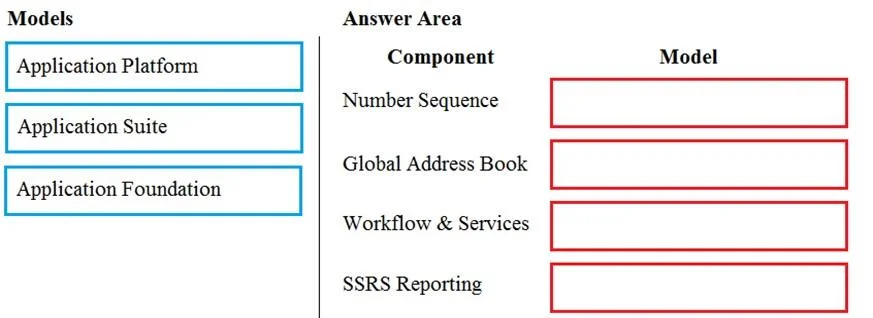
Answer Area
Drag items
Correct arrangement
- Application Foundation
- Application Foundation
- Application Platform
- Application Platform
Explanation
Dynamics 365 Finance: Component-to-Model Mapping
Note: The question as presented is missing the 4 component names (the drag targets). The answer below explains the model architecture and the logic behind the arrangement so you can apply it to whatever specific components appear on your exam.
The Three Standard Models (Layered Architecture)
The Dynamics 365 Finance application stack is organized into three layered models, from lowest to highest:
┌──────────────────────────┐
│     Application Suite    │  ← Business logic (AP, AR, GL, etc.)
├──────────────────────────┤
│  Application Foundation  │  ← Shared cross-app services
├──────────────────────────┤
│   Application Platform   │  ← Core runtime & infrastructure
└──────────────────────────┘
Each layer can only reference layers below it, never above.
What Belongs Where
Application Platform (Items 3 & 4 in the arrangement)
The lowest-level model. Contains runtime infrastructure that everything else depends on:
- Security framework (role-based access control)
- Batch processing framework
- Workflow engine infrastructure
- AOT (Application Object Tree) kernel objects
- SysSetup, SysPlugin, base X++ runtime classes
Rule of thumb: If it's needed before the application even starts, it's Platform.
Application Foundation (Items 1 & 2 in the arrangement)
The middle layer. Contains shared cross-application services used by all business modules:
- Global Address Book (GAB)
- Number sequences
- Organization model (legal entities, business units, operating units)
- Units of measure
- Currency framework
Rule of thumb: If it's a shared service that multiple business modules (GL, AR, AP) all consume equally, it's Foundation.
Application Suite (not used in this question)
The top layer. Contains actual business application modules:
- General Ledger, Accounts Payable, Accounts Receivable
- Inventory Management, Procurement, Project accounting
Why the Arrangement Is What It Is
| Position | Model | Reason |
|---|---|---|
| 1 | Application Foundation | This component is a shared cross-app service, not a raw runtime service |
| 2 | Application Foundation | Same - depends on Platform but is consumed by Suite-level modules |
| 3 | Application Platform | This component is core runtime infrastructure, referenced by both Foundation and Suite |
| 4 | Application Platform | Same - lowest-level dependency in the stack |
Application Suite is not used because none of the 4 components are business-module-specific functionality.
Common Misconceptions
-
Confusing Foundation with Suite - People assume "foundation" means everything fundamental. In D365, Foundation is specifically the shared services layer. Business modules (AP, GL) live in Suite.
-
Thinking Platform includes business logic - Platform is strictly the runtime engine. Nothing domain-specific (even currency) lives there.
-
Assuming the layer hierarchy is flat - These are true architectural dependencies. Suite references Foundation; Foundation references Platform. You cannot go the other way.
-
Placing Number Sequences in Platform - A very common mistake. Number sequences are a shared application service (Foundation), not a runtime kernel service (Platform).
If you can share the actual 4 component names from the exam, I can give you the precise reasoning for each specific placement.
Topics
Community Discussion
No community discussion yet for this question.