nerdexam
Microsoft

MB-335 · Question #244

Drag and Drop Question A furniture production company is implementing Dynamics 365 Supply Chain Management. The furniture goes through multiple stages of production with cutting wood, assembling the f

The correct answer is Production; BOM. Explanation: Configuring Screw Requirements in D365 Supply Chain Management Understanding the Scenario The key constraints are: Screws must not be itemized in inventory (no manual picking/tracking per unit) Must be used as needed during assembly Requires a flexible, reconfigurabl

Configure production prerequisites

Question

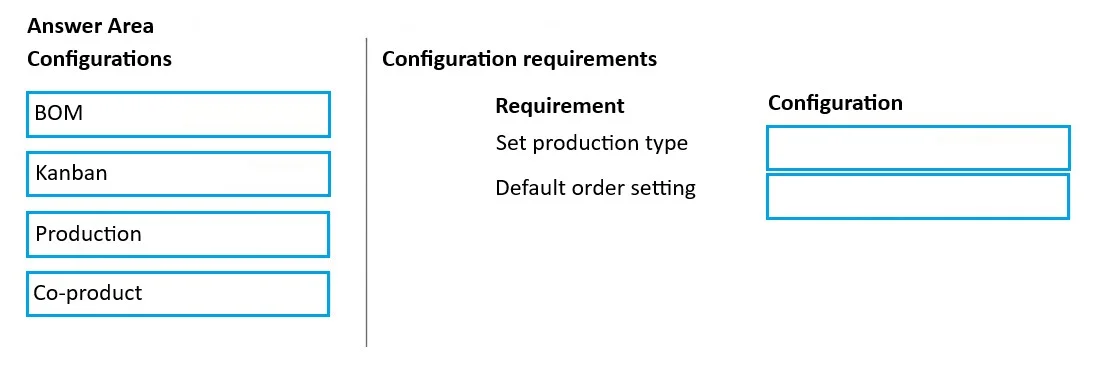
Drag and Drop Question A furniture production company is implementing Dynamics 365 Supply Chain Management. The furniture goes through multiple stages of production with cutting wood, assembling the furniture, and then applying paint. The production manager wants to ensure that the screws used for the assembly of the furniture are not itemized in inventory. Instead, they must be used as needed by the production team. This could change in the future and must have a flexible approach to configuration. You need to set up the production requirements for the screws. How should you configure the screw requirements? To answer, move the appropriate configurations to the correct requirements. You may use each configuration once, more than once, or not at all. You may need to move the split bar between panes or scroll to view content. NOTE: Each correct selection is worth one point. Answer:

Exhibit
MB-335 question #244 exhibit

Answer Area

Drag items

BOMKanbanProductionCo-product

Correct arrangement

  • Production
  • BOM

Explanation

Explanation: Configuring Screw Requirements in D365 Supply Chain Management

Understanding the Scenario

The key constraints are:

  • Screws must not be itemized in inventory (no manual picking/tracking per unit)
  • Must be used as needed during assembly
  • Requires a flexible, reconfigurable approach

Why the Correct Arrangement is: Production → BOM

Slot 1: Production

This refers to the supply type / production requirement type for the screws.

Setting this to Production means screws are tied to and consumed through the production order process. When a production order runs for furniture assembly, screws are automatically flushed/consumed based on the flushing principle - no manual inventory picking required. This directly satisfies the "not itemized in inventory" requirement.

Technical reason: In D365 SCM, setting the supply type to Production ensures the system generates the replenishment signal and consumption through the production execution flow, not through separate inventory transactions.

Slot 2: BOM (Bill of Materials)

Screws must be defined on the Bill of Materials of the furniture product.

The BOM is the structural definition of what components are needed to build the product. Adding screws to the BOM, with an appropriate flushing principle (e.g., "Start" or "Finish"), means they're consumed automatically without requiring individual inventory line items to be picked. The BOM approach is highly flexible - quantities, substitutions, and flushing behavior can be changed without redesigning the production flow.

Technical reason: BOM line configuration controls flushing (auto-consumption), which eliminates the need for manual inventory itemization while keeping screws traceable as a component cost.


Why the Wrong Answers Are Wrong

OptionWhy Incorrect
KanbanKanban is a pull-based replenishment system requiring physical/digital kanban signals and bin setup. It's less flexible to reconfigure and is overkill for a simple assembly component.
Co-productCo-products are outputs of a production process (e.g., sawdust from cutting wood), not inputs/components. Screws go into production - they are never a co-product.

Common Misconceptions

  • "Kanban = as needed, so it must be right." Kanban does mean pull/on-demand, but D365 Kanban requires dedicated kanban rules, warehouse setup, and isn't easily reconfigurable - contradicting the flexibility requirement.
  • "BOM means the screws are tracked in inventory." No - being on a BOM doesn't force inventory itemization. The flushing principle on the BOM line controls whether consumption is automatic or manual.
  • "Co-product handles shared/incidental materials." No - co-products are secondary produced outputs, not incidental consumed inputs.

Topics

#BOM#production configuration#inventory management#flexible manufacturing

Community Discussion

No community discussion yet for this question.

Full MB-335 Practice