MB-335 · Question #165
Drag and Drop Question A recreational vehicle (RV) manufacturing company is implementing Dynamics 365 Supply Chain Management. All RVs are configured to order. Quality checks show that there is an iss
The correct answer is Where-used; Configurator model attribute. Dynamics 365 SCM - Sealant Quality Issue Context RVs are configured to order, meaning they use Dynamics 365's constraint-based product configurator (not standard BOMs). This distinction drives both answers. --- Requirement 1: Identify which RV models use the sealant → Where-used
Question
Drag and Drop Question A recreational vehicle (RV) manufacturing company is implementing Dynamics 365 Supply Chain Management. All RVs are configured to order. Quality checks show that there is an issue with the sealant used with the windows in some of the RVs. You need to identify which RV models use the sealant and change the sealant item. Which function should you use for each requirement? To answer, drag the appropriate functions to the correct requirements. Each function may be used once, more than once, or not at all. You may need to drag the split bar between panes or scroll to view content. NOTE: Each correct selection is worth one point. Answer:
Exhibit
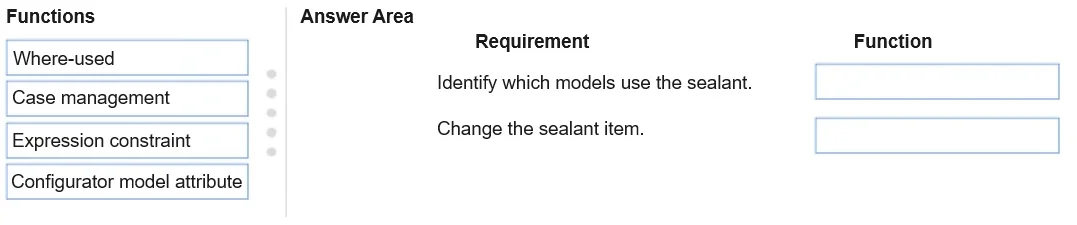
Answer Area
Drag items
Correct arrangement
- Where-used
- Configurator model attribute
Explanation
Dynamics 365 SCM - Sealant Quality Issue
Context
RVs are configured to order, meaning they use Dynamics 365's constraint-based product configurator (not standard BOMs). This distinction drives both answers.
Requirement 1: Identify which RV models use the sealant → Where-used
Why: The Where-used function performs an upward trace - given a specific item (the sealant), it returns every product configuration, BOM, or formula that references it. This is exactly what "identify which models use it" means.
- Navigate to the sealant item → run Where-used → get a list of all configurator models/BOMs that include it
- It answers: "Who depends on this item?"
Common mistake: Reaching for Case management here. Case management tracks quality incidents and non-conformances - it helps document that there's a problem, but it cannot tell you which products are affected.
Requirement 2: Change the sealant item → Configurator model attribute
Why: In constraint-based configuration, items used by a component are defined through attributes (typed variables on the configurator model). An attribute of type Item holds the reference to the specific sealant. To swap the sealant, you update that attribute - its default value or allowed-values table - in the configurator model.
- This propagates the change to all future configurations using that model
Common mistake: Choosing Expression constraint. Expression constraints define logical rules between attributes (e.g., "if WindowType = Panoramic, then SealantGrade must be Premium"). They govern when attributes apply - they don't hold the item reference itself.
Why the others are wrong
| Option | Why it doesn't fit |
|---|---|
| Case management | Tracks quality cases/NCRs, not item traceability or model changes |
| Expression constraint | Defines conditional logic in the configurator, not item assignments |
Key mental model
- Where-used = "which products depend on this item?" (trace upward)
- Configurator model attribute = "where the item is actually stored in a configure-to-order model" (update the value)
Topics
Community Discussion
No community discussion yet for this question.
