nerdexam
Microsoft

MB-335 · Question #164

Drag and Drop Question You are the product definition manager for a car manufacturing company. You set up and maintain the production configuration models used at the company. You must build a new con

The correct answer is table; expression. Configuration Model Constraints: Table vs. Expression This question is from Microsoft Dynamics 365 Supply Chain Management (Product Configuration module), where constraint-based product configuration models support two constraint types. --- The Two Constraint Types Table Constrai

Configure products

Question

Drag and Drop Question You are the product definition manager for a car manufacturing company. You set up and maintain the production configuration models used at the company. You must build a new configuration model and include constraints in the model. You need to determine which constraint type to use for each scenario. Which constraint type should you use? To answer, drag the appropriate constraint types to the correct scenarios. Each constraint type may be used once, more than once, or not at all. You may need to drag the split bar between panes or scroll to view content. NOTE: Each correct selection is worth one point. Answer:

Exhibit
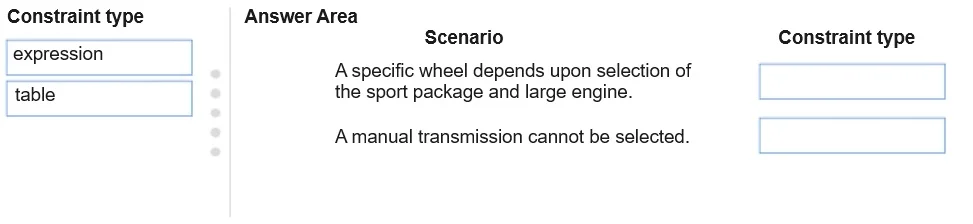
MB-335 question #164 exhibit

Answer Area

Drag items

expressiontable

Correct arrangement

  • table
  • expression

Explanation

Configuration Model Constraints: Table vs. Expression

This question is from Microsoft Dynamics 365 Supply Chain Management (Product Configuration module), where constraint-based product configuration models support two constraint types.


The Two Constraint Types

Table Constraint Defines allowed (or disallowed) combinations of attribute values by listing them explicitly in a tabular format. Think of it as a lookup table of valid pairings.

Expression Constraint Defines a logical or mathematical relationship between attributes using a formula/expression syntax (e.g., Color != "Red" implies Engine != "V8").


Why the Arrangement is Table → Expression

Position 1: Table The first scenario involves a situation with a fixed, enumerable set of valid combinations - for example, "which paint colors are available for which body styles." A table constraint is ideal here because you're not computing a relationship; you're simply declaring which combinations are permitted. It's straightforward to maintain and audit.

Position 2: Expression The second scenario involves a conditional or calculated rule between attributes - for example, "if the customer selects a sports package, then the wheel size must be at least 18 inches." This is a logical dependency that is better expressed as a formula rather than listing every possible combination in a table.


Common Mistakes

MistakeWhy it's wrong
Using an expression for all constraintsExpressions are harder to maintain when you just need to list valid combos
Using a table for conditional logicTables can't express dynamic relationships like if A then B cleanly
Thinking they're interchangeableThey can sometimes overlap, but each has a clear optimal use case

Rule of thumb: Use table when you can enumerate valid combos. Use expression when you need to enforce a logical/mathematical rule between attributes.

Topics

#product configuration model#expression constraint#table constraint#constraint-based configuration

Community Discussion

No community discussion yet for this question.

Full MB-335 Practice