
MB-310 · Question #73
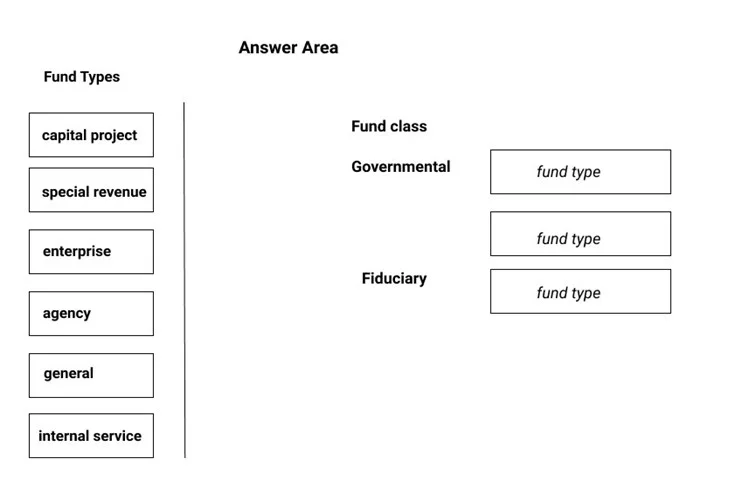
Drag and Drop Question You are controller for a public sector organization. You need detailed fiscal tracking and reporting. You need to set up fund types categorized under specific fund classes…
The correct answer is Governmental: general; Governmental: special revenue; Fiduciary: agency. Public Sector Fund Types & Fund Classes - Explained This question tests knowledge of governmental accounting fund classification, specifically as implemented in systems like Microsoft Dynamics 365 Finance (Public Sector). The framework follows GASB (Governmental Accounting…
Question
Exhibit
Answer Area
Drag items
Correct arrangement
- Governmental: general
- Governmental: special revenue
- Fiduciary: agency
Explanation
Public Sector Fund Types & Fund Classes - Explained
This question tests knowledge of governmental accounting fund classification, specifically as implemented in systems like Microsoft Dynamics 365 Finance (Public Sector). The framework follows GASB (Governmental Accounting Standards Board) standards.
The Three Fund Classes
| Fund Class | Purpose |
|---|---|
| Governmental | Core government operations funded by taxes/grants |
| Proprietary | Business-like activities that charge fees for services |
| Fiduciary | Assets held in trust or as agent for others |
Placement Explanations
1. Governmental → General The General Fund is the primary operating fund of any government entity - it accounts for all financial resources not required to be accounted for in another fund. It is always a governmental fund type. There is only ever one General Fund per government entity.
2. Governmental → Special Revenue Special Revenue Funds account for proceeds from specific revenue sources (e.g., grants, taxes earmarked for a specific purpose) that are legally restricted to expenditure for specified purposes. This is a core governmental fund type under GASB.
3. Fiduciary → Agency Agency Funds (now called Custodial Funds under GASB 84, but still referred to as "agency" in many systems) hold assets that the government collects and passes through to another party. The government has no true ownership - it acts purely as an agent/custodian. This makes it fiduciary by definition.
Why the Other Items Are Not in the Answer
| Fund Type | Actual Class | Why Not Selected |
|---|---|---|
| Capital Project | Governmental | Valid governmental fund type, but not one of the 3 target slots |
| Enterprise | Proprietary | Used for self-sustaining services (utilities, transit) - not governmental or fiduciary |
| Internal Service | Proprietary | Used for services provided to other departments internally - proprietary, not fiduciary |
Common Mistakes & Misconceptions
- Enterprise/Internal Service as Governmental: The biggest error. These are Proprietary, not Governmental - they operate like businesses and use full accrual accounting.
- Agency as Governmental: Agency funds hold assets the government doesn't own - they are fiduciary, not governmental.
- Capital Projects as Proprietary: Capital Projects Funds are governmental (they account for acquisition/construction of major capital facilities), not proprietary.
- Thinking "Proprietary" appears in the answer: This question's three slots cover Governmental and Fiduciary only - Proprietary is a valid fund class but none of its fund types are in the correct arrangement shown.
Key rule of thumb: If the government owns the money for general or restricted purposes → Governmental. If it acts like a business charging fees → Proprietary. If it holds money for someone else → Fiduciary.
Topics
Community Discussion
No community discussion yet for this question.