
MB-310 · Question #70
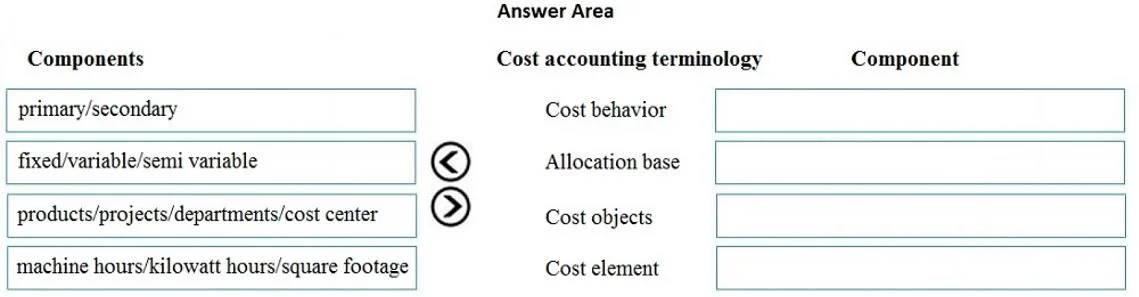
Drag and Drop Question You are a controller in an organization. You are identifying cost drivers to see how changes in business activities affect the bottom line of your organization. You need to…
The correct answer is fixed/variable/semi variable; machine hours/kilowatt hours/square footage; products/projects/departments/cost center; primary/secondary. Cost Accounting Terminology - Drag-and-Drop Explained The question presents four cost accounting terminology slots (unlabeled targets) and asks you to match each component. Based on standard cost accounting definitions, the implied terminology slots are: | # | Terminology Slot…
Question
Exhibit
Answer Area
Drag items
Correct arrangement
- fixed/variable/semi variable
- machine hours/kilowatt hours/square footage
- products/projects/departments/cost center
- primary/secondary
Explanation
Cost Accounting Terminology - Drag-and-Drop Explained
The question presents four cost accounting terminology slots (unlabeled targets) and asks you to match each component. Based on standard cost accounting definitions, the implied terminology slots are:
| # | Terminology Slot | Correct Component |
|---|---|---|
| 1 | Cost Behavior | fixed/variable/semi-variable |
| 2 | Cost Driver | machine hours/kilowatt hours/square footage |
| 3 | Cost Object | products/projects/departments/cost center |
| 4 | Cost Element Type | primary/secondary |
Placement 1 - Cost Behavior → fixed/variable/semi-variable
Cost behavior describes how a cost changes (or doesn't) in response to changes in business activity volume.
- Fixed: Stays constant regardless of output (e.g., rent)
- Variable: Changes proportionally with output (e.g., raw materials)
- Semi-variable: Has a fixed base plus a variable component (e.g., a utility bill with a base charge + usage charge)
This is foundational to budgeting and variance analysis - the exact context the question describes ("actual vs. budgeted cost").
Placement 2 - Cost Driver → machine hours/kilowatt hours/square footage
A cost driver is a measurable unit of activity that causes or correlates with cost consumption. It's used to allocate overhead and measure how resources are actually used.
- Machine hours → drives equipment and depreciation costs
- Kilowatt hours → drives energy costs
- Square footage → drives facility/occupancy costs
These are all quantifiable metrics that explain why a cost goes up or down - the core of identifying cost drivers as stated in the question.
Placement 3 - Cost Object → products/projects/departments/cost center
A cost object is anything for which you separately measure and accumulate costs. It's the "what are we measuring?" in cost analysis.
- Products → product costing
- Projects → project accounting
- Departments / Cost centers → responsibility accounting
The question specifically mentions "assessing cost object performance," directly referencing this term.
Placement 4 - Cost Element Type → primary/secondary
In cost accounting (especially in ERP systems like SAP CO), cost elements are classified as:
- Primary: Costs originating from external financial accounting (materials, salaries, utilities paid to outside vendors)
- Secondary: Costs created by internal allocations between cost centers (e.g., IT department recharging its costs to production)
This distinction matters for internal reporting - secondary costs are invisible on the external P&L but critical for internal cost analysis.
Common Misconceptions
| Mistake | Why it's wrong |
|---|---|
| Confusing cost driver with cost behavior | Behavior describes the pattern of change; a driver is the measurable cause of change |
| Treating "cost center" as a cost behavior concept | Cost centers are where costs collect (objects), not how costs behave |
| Thinking primary/secondary refers to importance | It refers to the origin of the cost (external vs. internal allocation), not priority |
| Placing machine hours under cost behavior | Hours are a measure of activity (driver), not a description of fixed/variable patterns |
Topics
Community Discussion
No community discussion yet for this question.