
MB-310 · Question #422
Drag and Drop Question A company uses Dynamics 365 Finance for its recurring contract billing. The company bills its customers a one-time fee when customers fist set up services. The company bills…
The correct answer is Flat; Flat tier. Dynamics 365 Finance - Billing Schedule Pricing Methods Context The company has two billing scenarios to configure: 1. A one-time setup fee charged when services are first established 2. A minimum charge plus actual usage billed using tiered pricing The four available pricing…
Question
Exhibit
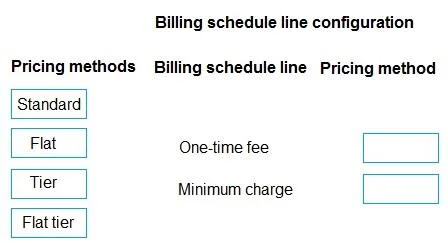
Answer Area
Drag items
Correct arrangement
- Flat
- Flat tier
Explanation
Dynamics 365 Finance - Billing Schedule Pricing Methods
Context
The company has two billing scenarios to configure:
- A one-time setup fee charged when services are first established
- A minimum charge plus actual usage billed using tiered pricing
The four available pricing methods in D365 Recurring Contract Billing are:
| Method | Behavior |
|---|---|
| Standard | Pulls price directly from released product or trade agreement - no tier logic |
| Flat | Fixed price per billing period, independent of quantity |
| Tier | Per-unit rate that changes based on which volume tier the quantity falls into |
| Flat tier | Each tier has a fixed flat amount (not per-unit) - suitable for minimum + tiered structures |
Position 1: Flat - One-time setup fee
The setup fee is a single fixed charge. It does not vary with quantity and is not tiered. Flat pricing maps exactly to this: it bills one set amount per billing period (or one-time), pulling the value from the released product sales price or trade agreement. No tier logic is needed or appropriate here.
Position 2: Flat tier - Minimum charge + tiered usage
The company needs a minimum floor charge combined with actual usage billed at tiered rates. Flat tier supports this by letting you define tiers where each tier carries a flat amount rather than a per-unit rate. The lowest tier captures the minimum charge; higher tiers capture progressively higher flat amounts based on usage bands. Prices for each tier are still manageable via trade agreements and released product sales prices, satisfying the company's pricing management requirement.
Why Not the Others?
- Standard - Correct for simple per-unit pricing from a trade agreement, but has no tier support. Cannot model minimum charges or usage tiers.
- Tier - Applies a per-unit rate that varies by tier. This is useful for true volume discounts (e.g., $5/unit for 1–100 units, $4/unit above 100), but does not model a flat minimum charge cleanly. Flat tier is the right choice when each tier has a fixed total price, not a rate.
Common Mistakes
- Choosing Tier instead of Flat tier for the usage scenario - the difference is per-unit rate vs. flat amount per tier. Exam questions often test exactly this distinction.
- Choosing Standard because the company uses trade agreements - Standard does use trade agreements, but it cannot apply tier logic. Flat and Flat tier also respect trade agreement pricing while adding the billing structure needed.
- Applying Flat to the tiered usage line - Flat is a single fixed price with no tiers, so it cannot model a minimum + variable usage structure.
Topics
Community Discussion
No community discussion yet for this question.