
MB-310 · Question #324
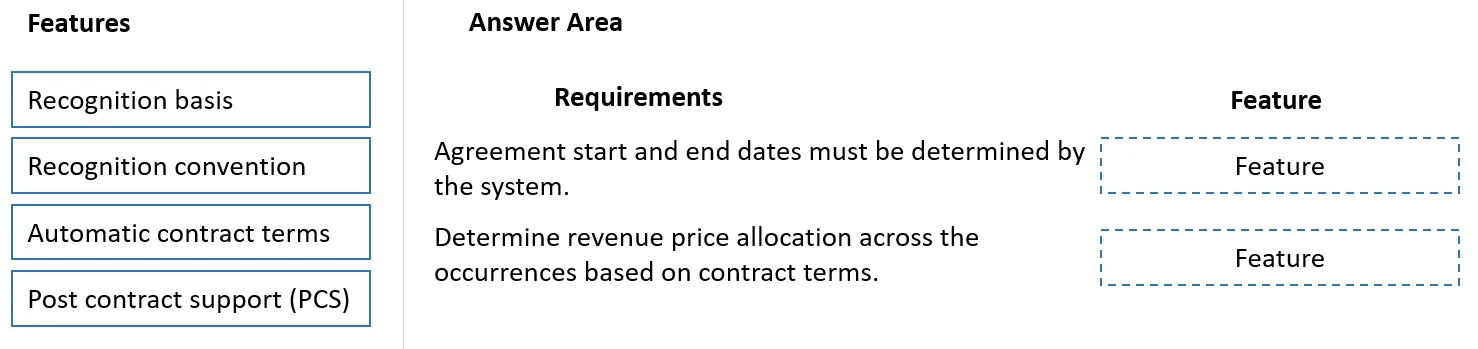
Drag and Drop Question You are implementing revenue recognition functionality in Microsoft Dynamics 365 Finance. You need to configure revenue schedules to meet the following requirements…
The correct answer is Automatic contract terms; Recognition basis. Drag-and-Drop Explanation: Revenue Schedules in D365 Finance The Two Requirements and Their Answers --- Requirement 1: Agreement start and end dates must be determined by the system Answer: Automatic contract terms In D365 Finance Revenue Recognition, Automatic contract terms…
Question
Exhibit
Answer Area
Drag items
Correct arrangement
- Automatic contract terms
- Recognition basis
Explanation
Drag-and-Drop Explanation: Revenue Schedules in D365 Finance
The Two Requirements and Their Answers
Requirement 1: Agreement start and end dates must be determined by the system Answer: Automatic contract terms
In D365 Finance Revenue Recognition, Automatic contract terms is a feature that automatically calculates the start and end dates of a revenue schedule based on predefined rules - without requiring manual date entry. When enabled, the system derives the contract period dates from the transaction or item setup, removing human input from that process. This is the only feature among the options that directly addresses date determination by the system.
Requirement 2: Determine revenue price allocation across the occurrences based on contract terms Answer: Recognition basis
Recognition basis defines how deferred revenue is spread across the schedule periods (occurrences). It controls the allocation method - for example, whether revenue is recognized equally across periods, based on milestones, or by specific percentages. It directly answers "how is the revenue price distributed across the schedule?" based on the terms of the contract.
Why the Other Options Are Wrong Here
| Feature | Why It Doesn't Fit |
|---|---|
| Recognition convention | Controls when within a period revenue is first recognized (e.g., first day, last day, half-period). It governs timing of the first occurrence, not date determination or allocation across occurrences. |
| Post contract support (PCS) | Relates to support obligations bundled with a sale (like ongoing maintenance). It's a type of performance obligation, not a scheduling or allocation mechanism. |
Common Misconceptions
- Confusing Recognition convention with Automatic contract terms: Students often think "convention" implies system-driven automation. It doesn't - it only governs the start point of recognition timing, not date calculation.
- Confusing Recognition basis with Recognition convention: "Basis" = how revenue is spread; "Convention" = when in the first period recognition starts. These are frequently swapped.
- Thinking PCS handles scheduling: PCS is about what is being recognized (a support element), not how the schedule dates or amounts are determined.
Topics
Community Discussion
No community discussion yet for this question.