
DP-300 · Question #266
Hotspot Question You have an Azure subscription. You need to deploy an Azure SQL managed instance that meets the following requirements: - Optimize latency. - Maximize the memory-to-vCore ratio…
Azure SQL Managed Instance - Service Tier & Hardware Generation --- Dropdown 1: Service Tier -> Business Critical Why Business Critical is correct: Business Critical uses local NVMe SSD storage (attached directly to the compute node) rather than remote storage. This eliminates…
Question
Exhibit
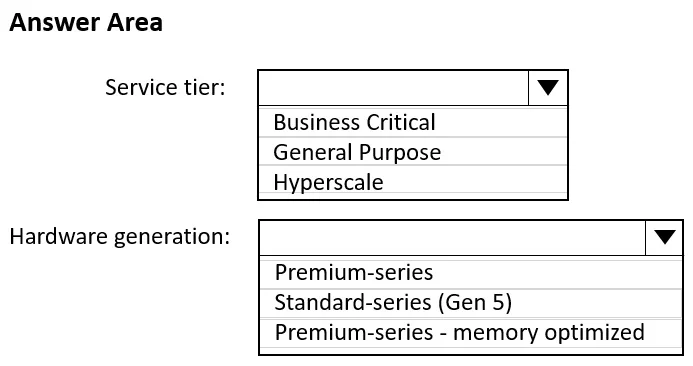
Answer Area
- Service tier:Business CriticalGeneral PurposeHyperscale
- Hardware generation:Premium-seriesStandard-series (Gen 5)Premium-series - memory optimized
Explanation
Azure SQL Managed Instance - Service Tier & Hardware Generation
Dropdown 1: Service Tier -> Business Critical
Why Business Critical is correct: Business Critical uses local NVMe SSD storage (attached directly to the compute node) rather than remote storage. This eliminates network round-trips for I/O, delivering the lowest possible read/write latency. It also includes a built-in read replica (free) and supports In-Memory OLTP.
Why the others are wrong:
- General Purpose - Uses remote Azure Premium Storage (networked). Higher latency inherently because I/O crosses a network boundary.
- Hyperscale - Uses a distributed, multi-layer architecture (page servers, log service). Designed for massive scale and fast backups, not minimum latency. I/O paths are more complex.
Core concept: Local vs. remote storage is the decisive factor for I/O latency in SQL Managed Instance tiers.
Dropdown 2: Hardware Generation -> Premium-series - memory optimized
Why Premium-series memory optimized is correct: This generation is explicitly engineered to maximize the memory-to-vCore ratio - it provides approximately 13.6 GB RAM per vCore, roughly 2Ã- that of standard Premium-series.
Why the others are wrong:
- Standard-series (Gen 5) - ~5.1 GB per vCore. Baseline option, lowest memory density of the three.
- Premium-series - ~7 GB per vCore. Better than Gen 5 but uses AMD EPYC for raw CPU performance gains, not memory maximization.
Core concept: The memory-optimized variant trades balanced compute for the highest RAM density per vCore, ideal for in-memory workloads, large buffer pools, or in-memory OLTP.
Summary Table
| Requirement | Correct Choice | Reason |
|---|---|---|
| Optimize latency | Business Critical | Local NVMe SSD - no remote I/O |
| Max memory-to-vCore ratio | Premium-series - memory optimized | ~13.6 GB/vCore vs. 7 GB and 5.1 GB |
Topics
Community Discussion
No community discussion yet for this question.