
DP-300 · Question #264
Hotspot Question You have an Azure subscription. You plan to migrate 10 on-premises Microsoft SQL Server instances to Azure. You need to ensure that the migrated environment can be managed by using…
Azure Multiserver Administration: MSX/TSX SQL Deployment Options Background Concept SQL Server Agent multiserver administration uses a master server (MSX) that distributes jobs to registered target servers (TSX). This requires full SQL Server Agent support - not all Azure SQL…
Question
Exhibit
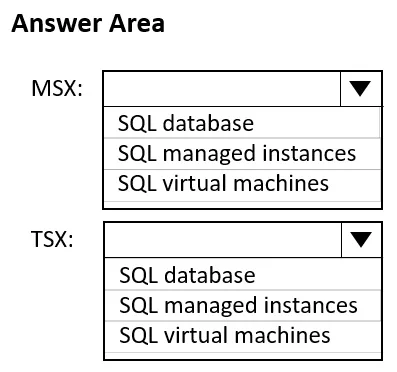
Answer Area
- MSX:SQL databaseSQL managed instancesSQL virtual machines
- TSX:SQL databaseSQL managed instancesSQL virtual machines
Explanation
Azure Multiserver Administration: MSX/TSX SQL Deployment Options
Background Concept
SQL Server Agent multiserver administration uses a master server (MSX) that distributes jobs to registered target servers (TSX). This requires full SQL Server Agent support - not all Azure SQL deployment options provide this.
Dropdown 1: MSX (Master Server)
Correct Answer: SQL Managed Instance
| Option | Verdict | Reason |
|---|---|---|
| SQL Managed Instance | Correct | Full SQL Server Agent support, including the ability to act as MSX. It's a PaaS service - no OS/infrastructure management required, minimizing admin effort. |
| SQL Virtual Machines | Wrong | Technically supports MSX, but it's IaaS - you manage the OS, patching, and infrastructure. This violates the "minimize administrative effort" requirement. |
| SQL Database | Wrong | Does not support SQL Server Agent multiserver administration at all. Uses Elastic Jobs instead, which is a completely different (and incompatible) mechanism. |
Dropdown 2: TSX (Target Servers)
Correct Answer: SQL Managed Instance
| Option | Verdict | Reason |
|---|---|---|
| SQL Managed Instance | Correct | Supports SQL Server Agent and can be enrolled as a TSX under an MSX. PaaS model again minimizes admin overhead across all 10 migrated instances. |
| SQL Virtual Machines | Wrong | Can technically be a TSX, but IaaS overhead across 10 VMs is significant. Fails the "minimize administrative effort" requirement at scale. |
| SQL Database | Wrong | No SQL Server Agent TSX support whatsoever. Cannot participate in MSX/TSX job distribution. |
Key Rule to Remember
MSX/TSX multiserver administration requires SQL Server Agent, which is only fully supported in SQL Managed Instance and SQL Virtual Machines. Since the requirement is to minimize admin effort, Managed Instance wins over VMs in both roles - it's the only option that satisfies both technical compatibility and the operational constraint.
Topics
Community Discussion
No community discussion yet for this question.