
DP-100 · Question #7
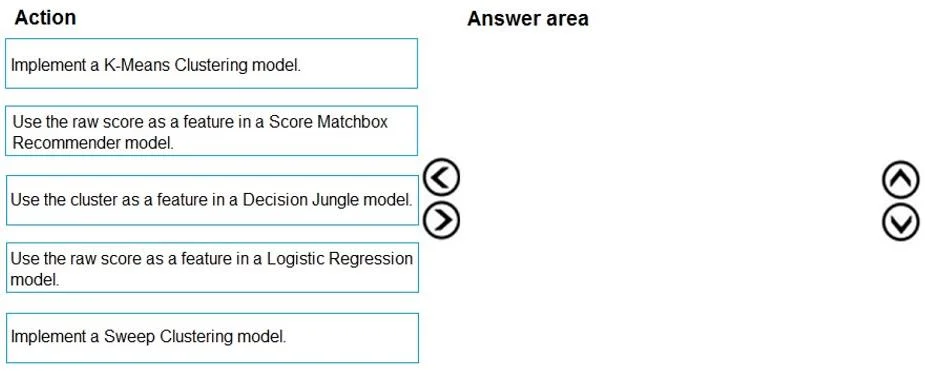
Drag and Drop Question You need to define a modeling strategy for ad response. Which three actions should you perform in sequence? To answer, move the appropriate actions from the list of actions to…
The correct answer is 1. Implement a K-Means Clustering model. 3. Use the cluster as a feature in a Decision Jungle model. 4. Use the raw score as a feature in a Logistic Regression model. This question tests knowledge of a multi-stage machine learning pipeline for ad response (click-through) prediction using a stacking/chaining strategy in Azure Machine Learning. The correct sequence builds progressively richer features by chaining unsupervised and supervised…
Question
Exhibit
Options
- 1Implement a K-Means Clustering model.
- 2Use the raw score as a feature in a Score Matchbox Recommender model.
- 3Use the cluster as a feature in a Decision Jungle model.
- 4Use the raw score as a feature in a Logistic Regression model.
- 5Implement a Sweep Clustering model.
Why each option
This question tests knowledge of a multi-stage machine learning pipeline for ad response (click-through) prediction using a stacking/chaining strategy in Azure Machine Learning. The correct sequence builds progressively richer features by chaining unsupervised and supervised models.
Concept tested: Multi-stage / stacked machine learning pipeline design for ad response prediction in Azure ML - combining unsupervised clustering (K-Means) with ensemble tree models (Decision Jungle) and a final calibrated classifier (Logistic Regression) in the correct dependency order.
Source: Microsoft Azure Machine Learning documentation - 'Train and evaluate clustering models' and 'Train classification models'; also covered in DP-100: Designing and Implementing a Data Science Solution on Azure exam objectives.
Topics
Community Discussion
No community discussion yet for this question.