
DP-100 · Question #6
Drag and Drop Question You need to define an evaluation strategy for the crowd sentiment models. Which three actions should you perform in sequence? To answer, move the appropriate actions from the…
The correct answer is Add new features for retraining supervised models.; Evaluate the changes in correlation between model error rate and centroid distance; Filter labeled cases for retraining using the shortest distance from centroids. This question tests understanding of iterative evaluation strategies for hybrid clustering-supervised sentiment models, specifically how centroid distance metrics guide feature engineering and data selection for retraining.
Question
Exhibit
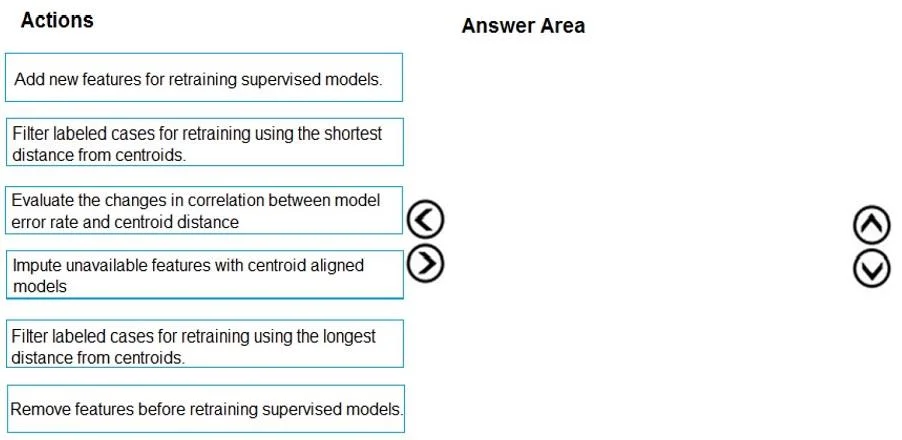
Answer Area
Drag items
Correct arrangement
- Add new features for retraining supervised models.
- Evaluate the changes in correlation between model error rate and centroid distance
- Filter labeled cases for retraining using the shortest distance from centroids
Explanation
This question tests understanding of iterative evaluation strategies for hybrid clustering-supervised sentiment models, specifically how centroid distance metrics guide feature engineering and data selection for retraining.
Approach. Step 1 - adding new features - enriches the supervised model before evaluating impact. Step 2 - evaluating the correlation between model error rate and centroid distance - is the diagnostic core: if samples far from cluster centroids consistently have higher error rates, centroid distance is a reliable proxy for model uncertainty. Step 3 - filtering labeled cases using the shortest centroid distance - selects the most representative, archetypal samples from each cluster for retraining, because these core cases best capture the true signal of each sentiment class and produce the most stable model updates.
Concept tested. Centroid-distance-guided evaluation in semi-supervised/hybrid sentiment models: using the relationship between clustering geometry (centroid distance) and supervised model error as a feedback signal, then leveraging cluster centroids to curate high-quality retraining data rather than relying on outliers or arbitrary sampling.
Reference. Microsoft Azure ML / DP-100 - Crowd Sentiment Model Evaluation with Clustering Feedback Loops
Topics
Community Discussion
No community discussion yet for this question.