
DP-100 · Question #8
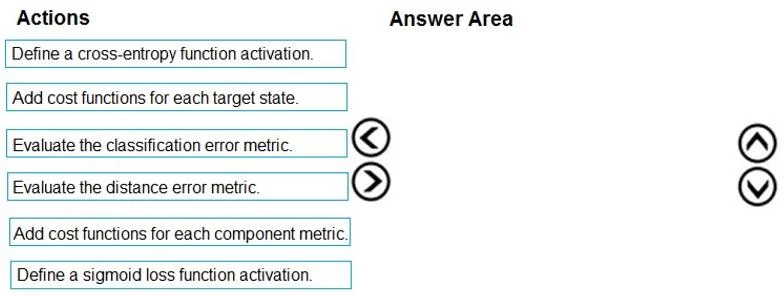
Drag and Drop Question You need to define an evaluation strategy for the crowd sentiment models. Which three actions should you perform in sequence? To answer, move the appropriate actions from the…
The correct answer is Define a cross-entropy function activation.; Add cost functions for each target state.; Evaluate the distance error metric. To define an evaluation strategy for crowd sentiment models, which are classification tasks, the correct sequence involves setting up appropriate cost functions for target states, defining a cross-entropy loss function, and then evaluating with classification-specific error…
Question
Exhibit
Answer Area
Drag items
Correct arrangement
- Define a cross-entropy function activation.
- Add cost functions for each target state.
- Evaluate the distance error metric.
Explanation
To define an evaluation strategy for crowd sentiment models, which are classification tasks, the correct sequence involves setting up appropriate cost functions for target states, defining a cross-entropy loss function, and then evaluating with classification-specific error metrics.
Approach. The question asks for three sequential actions to define an evaluation strategy for crowd sentiment models. Crowd sentiment analysis is fundamentally a classification problem (e.g., positive, negative, neutral sentiment). Therefore, the evaluation strategy must align with classification tasks.
-
Add cost functions for each target state. - In classification, a model aims to predict one of several 'target states' or classes. A cost function is essential to quantify the error or 'cost' of incorrect predictions for each of these states, guiding the model's learning process. This is a foundational step in setting up evaluation for multi-class problems.
-
Define a cross-entropy function activation. - Following the conceptual need for cost functions across target states, cross-entropy is the standard loss (or cost) function used for classification problems, especially when dealing with multiple classes. While 'activation' is technically a misnomer (cross-entropy is a loss function, often used with sigmoid or softmax activation functions), in the context of typical exam questions, it refers to specifying the cross-entropy loss function itself. This choice provides the specific mathematical method for calculating the cost.
-
Evaluate the classification error metric. - After the model has been trained using an appropriate loss function (like cross-entropy), its performance is assessed using specific evaluation metrics. For classification tasks, these are 'classification error metrics' such as accuracy, precision, recall, F1-score, etc., which directly measure the model's ability to correctly classify sentiment categories. This is the final step in evaluating the model's effectiveness.
Common mistakes.
- common_mistake. Add cost functions for each component metric: This phrasing is vague and less precise than 'Add cost functions for each target state' in the context of classification. 'Target state' directly refers to the classes or categories in a classification problem, making the previous choice more appropriate and standard terminology.
Concept tested. Evaluation strategies for machine learning models, specifically distinguishing between classification and regression metrics and understanding appropriate loss functions for classification tasks (like cross-entropy for sentiment analysis).
Topics
Community Discussion
No community discussion yet for this question.