
DP-100 · Question #61
Drag and Drop Question You are building an intelligent solution using machine learning models. The environment must support the following requirements: - Data scientists must build notebooks in a…
The correct answer is Create an Azure HDInsight cluster to include the Apache Spark Mllib library.; Install Microsoft Machine Learning for Apache Spark.; Create and execute the Zeppelin notebooks on the cluster.; When the cluster is ready, export Zeppelin notebooks to a local environment. To build an intelligent solution with specific machine learning requirements, the correct sequence involves provisioning an HDInsight Spark cluster, installing the Azure Machine Learning SDK for AutoML, creating and executing a Jupyter notebook, and finally exporting the…
Question
Exhibit
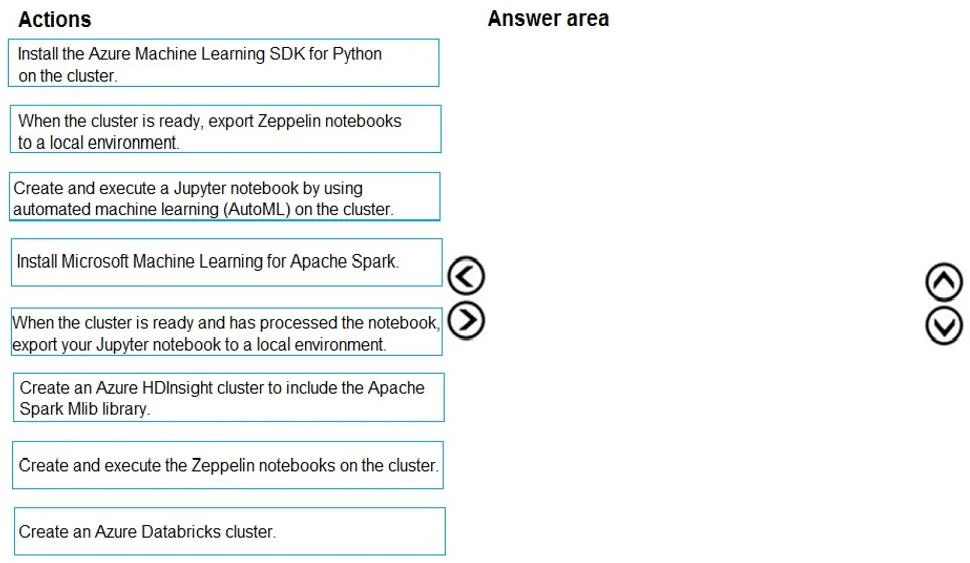
Answer Area
Drag items
Correct arrangement
- Create an Azure HDInsight cluster to include the Apache Spark Mllib library.
- Install Microsoft Machine Learning for Apache Spark.
- Create and execute the Zeppelin notebooks on the cluster.
- When the cluster is ready, export Zeppelin notebooks to a local environment.
Explanation
To build an intelligent solution with specific machine learning requirements, the correct sequence involves provisioning an HDInsight Spark cluster, installing the Azure Machine Learning SDK for AutoML, creating and executing a Jupyter notebook, and finally exporting the notebook for version control.
Approach. The correct interaction requires dragging four specific actions from the 'Actions' list to the 'Answer area' and arranging them in the following logical sequence:
-
Create an Azure HDInsight cluster to include the Apache Spark Mlib library.
- Reasoning: The first step in setting up any cloud-based environment is to provision the necessary infrastructure. The requirements specify 'Spark instances with dynamic worker allocation', and Azure HDInsight is a managed Spark service that fits this, specifically including the Apache Spark Mlib library for machine learning tasks.
-
Install the Azure Machine Learning SDK for Python on the cluster.
- Reasoning: The requirements state that 'Data scientists must use automatic feature engineering and model building in machine learning pipelines'. This capability is provided by Azure Machine Learning's Automated ML (AutoML) feature, which requires the Azure Machine Learning SDK for Python to be installed on the compute cluster (in this case, the HDInsight Spark cluster).
-
Create and execute a Jupyter notebook by using automated machine learning (AutoML) on the cluster.
- Reasoning: With the cluster provisioned and the necessary SDK installed, the next logical step is to develop and run the actual machine learning solution. This action directly addresses the requirement for 'Data scientists must build notebooks in a cloud environment' and explicitly uses 'automated machine learning (AutoML)', tying back to the previous SDK installation.
-
When the cluster is ready and has processed the notebook, export your Jupyter notebook to a local environment.
- Reasoning: The final requirement is that 'Notebooks must be exportable to be version controlled locally'. After the Jupyter notebook has been created and executed on the cluster, it needs to be exported. This action directly fulfills that requirement for the Jupyter notebook developed in the previous step.
Common mistakes.
- common_mistake. Common mistakes include choosing an incorrect cluster type (e.g., Azure Databricks cluster, while also a Spark service, the HDInsight option with Mlib is more specific given the problem statement and other options), choosing Zeppelin notebooks over Jupyter (the question explicitly mentions AutoML in conjunction with Jupyter in a key option), installing Microsoft Machine Learning for Apache Spark instead of the Azure Machine Learning SDK (AutoML specifically leverages the Azure ML SDK for automated model building, which is a core requirement), or misordering the steps (e.g., trying to install SDKs or run notebooks before the cluster is created, or exporting before creation). For instance, installing an SDK before creating the cluster, or trying to create/export notebooks for a type of notebook not used (e.g. Zeppelin notebooks after choosing Jupyter development).
Concept tested. The core concept tested is the ability to plan and sequence the setup of an Azure-based machine learning environment, including choosing appropriate Azure services (HDInsight Spark), installing necessary libraries (Azure Machine Learning SDK for Python), performing development tasks (Jupyter notebooks with AutoML), and fulfilling operational requirements (exporting notebooks for version control). It assesses knowledge of Azure Machine Learning, Spark, and development workflows.
Topics
Community Discussion
No community discussion yet for this question.