
AZ-800 · Question #28
Drag and Drop Question You deploy a new Active Directory Domain Services (AD DS) forest named contoso.com. The domain contains three domain controllers named DC1, DC2, and DC3. You rename…
The correct answer is Create two additional sites named Site2 and Site3. Move DC2 to Site2 and DC3 to Site3.; Create an additional site link that contains Site1 and Site2.; Remove Site2 from DEFAULTTIPSITELINK. The correct approach involves first establishing the required Active Directory sites and moving domain controllers, then creating a specific site link to define replication paths, and finally removing the site from the default link to ensure independent control over replication…
Question
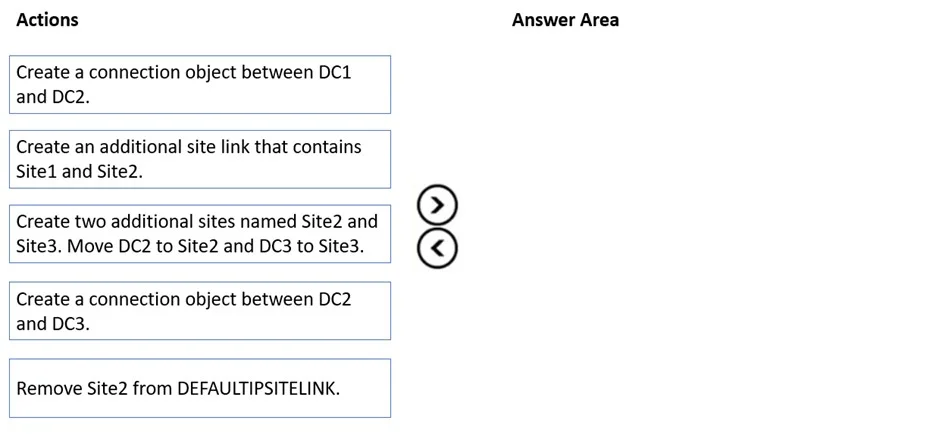
Drag and Drop Question You deploy a new Active Directory Domain Services (AD DS) forest named contoso.com. The domain contains three domain controllers named DC1, DC2, and DC3. You rename Default-First-Site-Name as Site1. You plan to ship DC1, DC2, and DC3 to datacenters in different locations. You need to configure replication between DC1, DC2, and DC3 to meet the following requirements:
Each domain controller must reside in its own Active Directory site. The replication schedule between each site must be controlled independently. Interruptions to replication must be minimized. Which three actions should you perform in sequence in the Active Directory Sites and Services console? To answer, move the appropriate actions from the list of actions to the answer area and arrange them in the correct order. Answer:
Exhibit
Answer Area
Drag items
Correct arrangement
- Create two additional sites named Site2 and Site3. Move DC2 to Site2 and DC3 to Site3.
- Create an additional site link that contains Site1 and Site2.
- Remove Site2 from DEFAULTTIPSITELINK.
Explanation
The correct approach involves first establishing the required Active Directory sites and moving domain controllers, then creating a specific site link to define replication paths, and finally removing the site from the default link to ensure independent control over replication schedules.
Approach. The correct sequence of actions to configure Active Directory replication to meet the specified requirements for independent control and minimal interruption is as follows:
- 'Create two additional sites named Site2 and Site3. Move DC2 to Site2 and DC3 to Site3.' This is the essential first step. Before configuring inter-site replication or specific site links, the Active Directory sites must be created, and the domain controllers must be assigned to their respective new sites. This directly fulfills the requirement that 'Each domain controller must reside in its own Active Directory site.'
- 'Create an additional site link that contains Site1 and Site2.' Once the sites are established with their domain controllers, custom site links are needed to define specific replication paths and schedules, addressing the requirement for 'independent replication schedule between each site.' It is crucial to create this new site link before modifying the default link. This minimizes replication interruptions by ensuring a new, explicitly defined path is available before an existing default path is removed.
- 'Remove Site2 from DEFAULTIPSITELINK.' This final step ensures that replication involving Site2 will now exclusively use the explicitly created site links (like the Site1-Site2 link) rather than the less granular
DEFAULTIPSITELINK. By removing Site2 from the default link, administrators gain full independent control over the replication schedule and configuration for Site2, directly meeting the requirement to control schedules independently and preventing fallback to the default configuration. This also aligns with minimizing interruptions, as the new link was established in the prior step.
Common mistakes.
- common_mistake. Common mistakes include:
- Manually creating connection objects: Actions such as 'Create a connection object between DC1 and DC2' or 'Create a connection object between DC2 and DC3' are generally incorrect as primary steps. The Knowledge Consistency Checker (KCC) automatically generates and maintains connection objects based on the configured sites and site links. Manual creation is usually discouraged unless specific, advanced troubleshooting or custom topologies where the KCC cannot achieve the desired result are required. Attempting to create them manually as a primary configuration step is premature and can interfere with KCC's automated processes.
- Incorrect order of operations: For example, removing Site2 from
DEFAULTIPSITELINKbefore creating a new site link for it could disrupt replication, as no alternative path would be immediately available. Similarly, attempting to create site links or move domain controllers before the target sites exist is illogical. The logical progression is to first establish the foundational site structure, then define the new custom replication paths, and finally remove any conflicting or less granular default paths.
Concept tested. Active Directory Sites and Services, specifically the configuration and management of inter-site replication, the role of sites and site links, the function and implications of the DEFAULTIPSITELINK, and the automated role of the Knowledge Consistency Checker (KCC) in creating connection objects. The question tests the ability to design an AD replication topology that meets specific requirements for independent control over replication schedules and minimal service interruption.
Topics
Community Discussion
No community discussion yet for this question.