
AZ-305 · Question #336
Hotspot Question You have 10 on-premises servers that run Windows Server. You need to perform daily backups of the servers to a Recovery Services vault. The solution must meet the following…
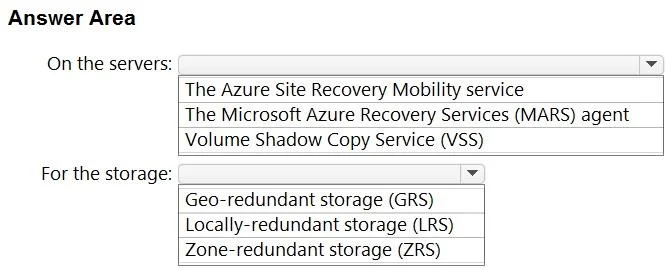
The correct answer is On the servers:: The Microsoft Azure Recovery Services (MARS) agent; For the storage:: Locally-redundant storage (LRS). Hotspot Explanation: Backing Up On-Premises Servers to a Recovery Services Vault --- Dropdown 1: On the servers - Microsoft Azure Recovery Services (MARS) agent Why MARS is correct: MARS is specifically designed for backing up files, folders, and system state from on-premises…
Question
Exhibit
Answer Area
- On the servers:The Microsoft Azure Recovery Services (MARS) agentThe Azure Site Recovery Mobility serviceThe Microsoft Azure Recovery Services (MARS) agentVolume Shadow Copy Service (VSS)
- For the storage:Locally-redundant storage (LRS)Geo-redundant storage (GRS)Locally-redundant storage (LRS)Zone-redundant storage (ZRS)
Explanation
Hotspot Explanation: Backing Up On-Premises Servers to a Recovery Services Vault
Dropdown 1: On the servers - Microsoft Azure Recovery Services (MARS) agent
Why MARS is correct: MARS is specifically designed for backing up files, folders, and system state from on-premises Windows servers directly to an Azure Recovery Services vault. It runs as a lightweight agent on each server, handles scheduling, and supports the exact requirement: file/folder backup to Azure.
Why the alternatives are wrong:
- Azure Site Recovery Mobility service - This is for disaster recovery (replicating entire VMs for failover), not for file/folder backup. It doesn't integrate with Recovery Services vaults for backup purposes.
- Volume Shadow Copy Service (VSS) - VSS is a Windows-native technology that creates point-in-time snapshots locally. It's a component MARS uses internally, but VSS alone does not back up data to Azure. You can't configure VSS to send backups to a Recovery Services vault.
Key concept: MARS agent is the standard solution for agent-based, file-level backup of on-premises Windows machines to Azure Recovery Services vaults.
Dropdown 2: For the storage - Locally-redundant storage (LRS)
Why LRS is correct: The requirement says "maintain three copies of the backups in Azure" and minimize costs. LRS stores exactly three copies of data within a single Azure datacenter (one region, one availability zone). It is the cheapest redundancy tier and directly satisfies the "three copies" requirement.
Why the alternatives are wrong:
- Geo-redundant storage (GRS) - GRS stores six copies (3 locally + 3 in a paired region hundreds of miles away). This exceeds the three-copy requirement and costs significantly more. Only use GRS if you need protection against a full regional outage.
- Zone-redundant storage (ZRS) - ZRS stores three copies across three availability zones within a region. While it also provides three copies, it costs more than LRS and adds zone-level redundancy that wasn't required by the scenario.
Key concept: Recovery Services vaults let you choose the storage replication type. When the requirement explicitly states three copies and minimize costs, LRS is the precise and cheapest match - it was designed for exactly this: three synchronous copies in one location.
Summary Table
| Dropdown | Correct Choice | Reason |
|---|---|---|
| On the servers | MARS agent | File/folder backup from on-premises Windows to Azure vault |
| Storage type | LRS | Exactly 3 copies, lowest cost |
Topics
Community Discussion
No community discussion yet for this question.