
AZ-305 · Question #208
Hotspot Question You have an on-premises file server that stores 2 TB of data files. You plan to move the data files to Azure Blob storage in the Central Europe region. You need to recommend a…
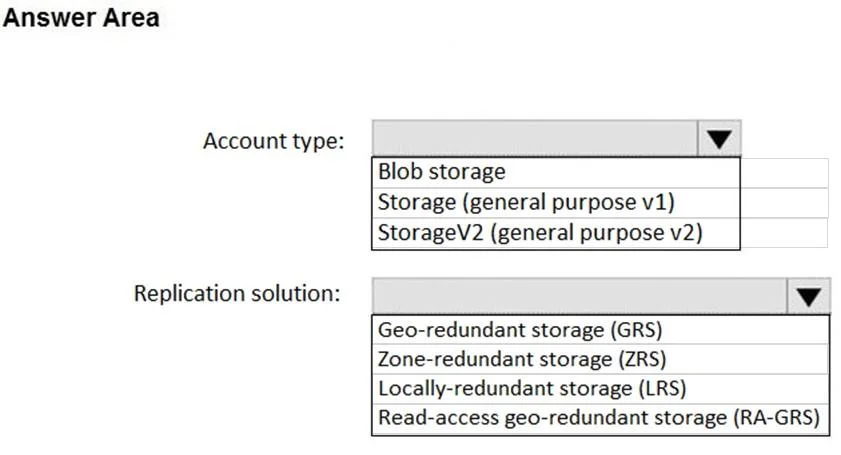
The correct answer is Account type:: StorageV2 (general purpose v2); Replication solution:: Zone-redundant storage (ZRS). This question tests knowledge of Azure Storage account types and replication options, requiring you to select the most cost-effective combination that survives a single datacenter failure and supports storage tiers.
Question
Exhibit
Answer Area
- Account type:StorageV2 (general purpose v2)Blob storageStorage (general purpose v1)StorageV2 (general purpose v2)
- Replication solution:Zone-redundant storage (ZRS)Geo-redundant storage (GRS)Zone-redundant storage (ZRS)Locally-redundant storage (LRS)Read-access geo-redundant storage (RA-GRS)
Explanation
This question tests knowledge of Azure Storage account types and replication options, requiring you to select the most cost-effective combination that survives a single datacenter failure and supports storage tiers.
Approach. The correct storage account type is 'General Purpose v2 (GPv2)' because it supports all storage tiers (Hot, Cool, and Archive) and is required for Blob storage tiering - GPv1 and legacy Blob storage accounts do not support all tiers. The correct replication option is 'Zone-Redundant Storage (ZRS)' because ZRS replicates data synchronously across three Azure availability zones within a single region, ensuring availability if a single datacenter (availability zone) fails. ZRS is less expensive than Geo-Redundant Storage (GRS) or Read-Access Geo-Redundant Storage (RA-GRS), which replicate to a secondary region unnecessarily for this requirement, and more resilient than Locally Redundant Storage (LRS), which only replicates within a single datacenter and would not survive a datacenter failure.
Concept tested. Azure Storage account types (GPv2 vs GPv1 vs BlobStorage) and replication strategies (LRS, ZRS, GRS, RA-GRS), specifically understanding which combination meets availability requirements (single datacenter failure tolerance), supports storage tiers, and minimizes cost.
Reference. https://learn.microsoft.com/en-us/azure/storage/common/storage-redundancy and https://learn.microsoft.com/en-us/azure/storage/blobs/storage-blob-storage-tiers
Topics
Community Discussion
No community discussion yet for this question.