
AZ-305 · Question #207
Hotspot Question Your company deploys an Azure App Service Web App. During testing the application fails under load. The application cannot handle more than 100 concurrent user sessions. You enable…
This hotspot question tests knowledge of Azure App Service scaling strategies and performance optimization techniques when an application fails under load with concurrent user session limits.
Question
Exhibit
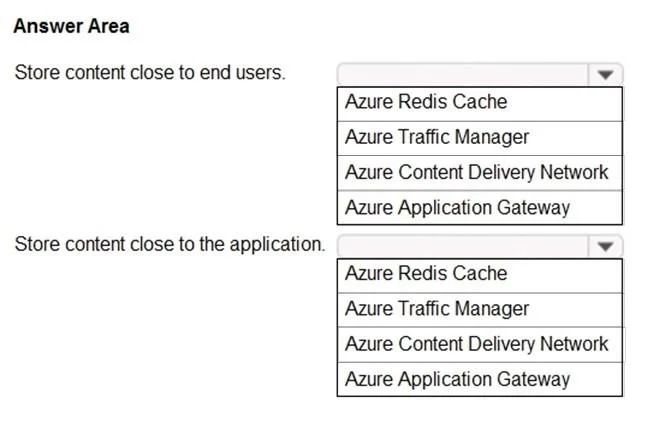
Answer Area
- Store content close to end users.Azure Redis CacheAzure Traffic ManagerAzure Content Delivery NetworkAzure Application Gateway
- Store content close to the application.Azure Redis CacheAzure Traffic ManagerAzure Content Delivery NetworkAzure Application Gateway
Explanation
This hotspot question tests knowledge of Azure App Service scaling strategies and performance optimization techniques when an application fails under load with concurrent user session limits.
Approach. When an application cannot handle more than 100 concurrent user sessions and auto-scaling is already configured, the root performance issues need to be addressed at the application tier level. For session handling issues, Azure Redis Cache should be used to offload session state management from the web app instances, allowing each instance to share session state across all scaled-out instances. For the scenario where the application still fails under load despite scaling out (horizontal scaling via auto-scaling is configured), scaling UP (vertical scaling) to a higher App Service Plan tier provides more CPU and memory per instance, addressing compute bottlenecks. The Always On feature prevents the app from being unloaded when idle, but does not solve concurrency limits - therefore using Azure CDN offloads static content delivery reducing server load, and using Azure Redis Cache for session state ensures session affinity issues are eliminated when scaling out to multiple instances.
Concept tested. Azure App Service performance optimization including the difference between scale-up (vertical) vs scale-out (horizontal) scaling, session state management with Azure Redis Cache, static content offloading with Azure CDN, and when each solution applies to specific failure scenarios under load.
Reference. https://docs.microsoft.com/en-us/azure/app-service/manage-scale-up and https://docs.microsoft.com/en-us/azure/azure-cache-for-redis/cache-aspnet-session-state-provider
Topics
Community Discussion
No community discussion yet for this question.