
AZ-305 · Question #206
Drag and Drop Question Your company identifies the following business continuity and disaster recovery objectives for virtual machines that host sales, finance, and reporting applications in the…
The correct answer is Azure Site Recovery only; Azure Site Recovery and Azure Backup; Azure Backup only. Azure BCDR Exam Question - Explanation Service Overview | Service | Purpose | |---|---| | Azure Site Recovery (ASR) | VM replication + orchestrated failover. Enables fast RTO (minutes). Targets secondary on-premises site or Azure. | | Azure Backup | Scheduled backups with…
Question
Exhibits
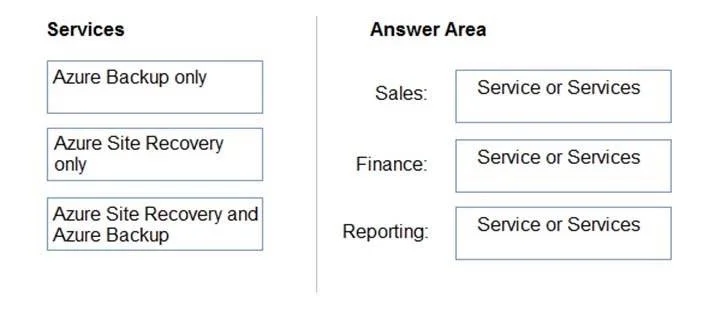
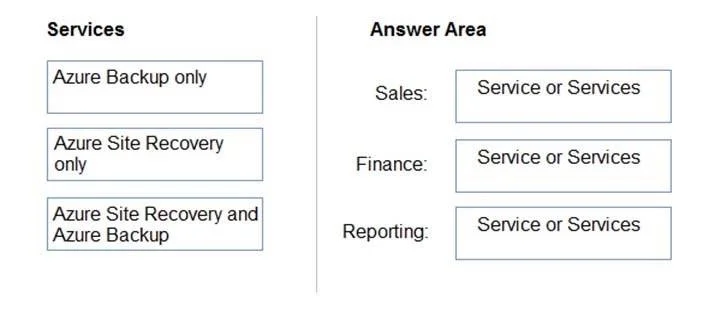
Answer Area
Drag items
Correct arrangement
- Azure Site Recovery only
- Azure Site Recovery and Azure Backup
- Azure Backup only
Explanation
Azure BCDR Exam Question - Explanation
Service Overview
| Service | Purpose |
|---|---|
| Azure Site Recovery (ASR) | VM replication + orchestrated failover. Enables fast RTO (minutes). Targets secondary on-premises site or Azure. |
| Azure Backup | Scheduled backups with configurable retention policies (daily/weekly/yearly, up to 99 years). Enables point-in-time restore. |
Placement 1 - Sales: Azure Site Recovery only
Requirement: Fail over to a second on-premises data center.
ASR is the correct tool because it continuously replicates VMs and orchestrates failover - including on-premises to on-premises (e.g., Hyper-V site-to-site via SCVMM). No backup retention requirement is stated, so Azure Backup adds cost without value here.
Common mistake: Adding Azure Backup when no retention or restore requirement exists.
Placement 2 - Finance: Azure Site Recovery and Azure Backup
Requirements: Run from Azure during disaster (RTO = 10 min) + retain data for 7 years.
- ASR handles the 10-minute RTO by replicating VMs to Azure and enabling near-instant failover.
- Azure Backup handles the 7-year retention policy, which ASR alone cannot provide - ASR is not a backup solution.
Both are required. Neither alone satisfies all requirements.
Common mistake: Using only ASR and overlooking the 7-year retention requirement, or assuming ASR doubles as long-term backup storage.
Placement 3 - Reporting: Azure Backup only
Requirements: Point-in-time recovery at daily granularity + RTO = 8 hours.
Azure Backup natively supports daily backup schedules with point-in-time restore. An 8-hour RTO is relaxed enough that a restore-from-backup approach is sufficient - no live replication is needed. Adding ASR would be over-engineered and unnecessarily expensive.
Common mistake: Adding ASR because the word "recovery" appears in the requirement. ASR solves failover, not point-in-time restore. The 8-hour RTO is the signal that backup (not replication) is the cost-appropriate solution.
Decision Framework
Need failover / low RTO (minutes)?     -> ASR
Need long-term retention or PITR?      -> Azure Backup
Both?                                  -> ASR + Azure Backup
Topics
Community Discussion
No community discussion yet for this question.