
AZ-305 · Question #378
Hotspot Question You have the following projects: - Project1: The development of an app that processes scanned images stored in an Azure Blob Storage account - Project2: The migration of an…
This hotspot question tests knowledge of appropriate Azure compute solutions for different workload types, storage requirements, and container support constraints.
Question
Exhibits
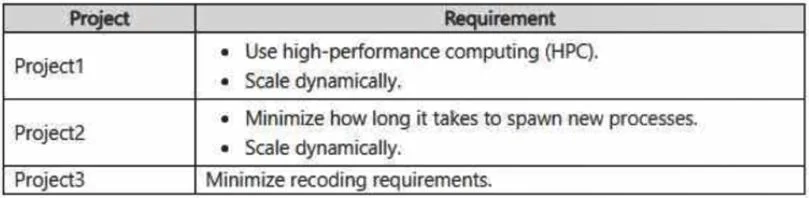
Answer Area
- Project1
- Use high-performance computing (HPC).
- Scale dynamically.
- Project2
- Minimize how long it takes to spawn new processes.
- Scale dynamically.
- Project3
- Minimize recoding requirements.
Explanation
This hotspot question tests knowledge of appropriate Azure compute solutions for different workload types, storage requirements, and container support constraints.
Approach. Project1 (blob storage image processing) should use Azure Functions with a Blob Storage trigger, as it natively integrates with Azure Blob Storage and is ideal for event-driven serverless processing of images. Project2 (SMB file share log processing) should use Azure Functions with an Azure Files trigger or an App Service with Azure Files mount, but since it requires SMB file share compatibility, Azure App Service (or a VM-based solution) with Azure Files integration is appropriate - however, the best fit here is Azure Functions with a Timer or File trigger backed by Azure Files. Project3 (PDF processing from local file system, no containers) must use Azure Virtual Machines because it cannot use containers, needs access to a local file system equivalent, and is a lift-and-shift migration of an on-premises app without container support. In summary: Project1 = Azure Functions (serverless, blob trigger), Project2 = Azure App Service or Azure Functions with Azure Files (SMB support), Project3 = Azure Virtual Machines (no container support, local file system requirement).
Concept tested. Selecting the correct Azure compute service (Azure Functions, Azure App Service, Azure Virtual Machines) based on workload characteristics such as storage type (Blob, SMB/Azure Files, local filesystem), event-driven vs. scheduled processing, and container support constraints.
Reference. https://learn.microsoft.com/en-us/azure/architecture/guide/technology-choices/compute-decision-tree
Topics
Community Discussion
No community discussion yet for this question.