
AZ-305 · Question #123
Hotspot Question You plan to develop a new app that will store business critical data. The app must meet the following requirements: - Prevent new data from being modified for one year. - Maximize…
The recommended solution combines Premium block blobs for low latency and RA-GRS for maximum data resiliency and geo-redundancy, while supporting immutable storage policies.
Question
Exhibits
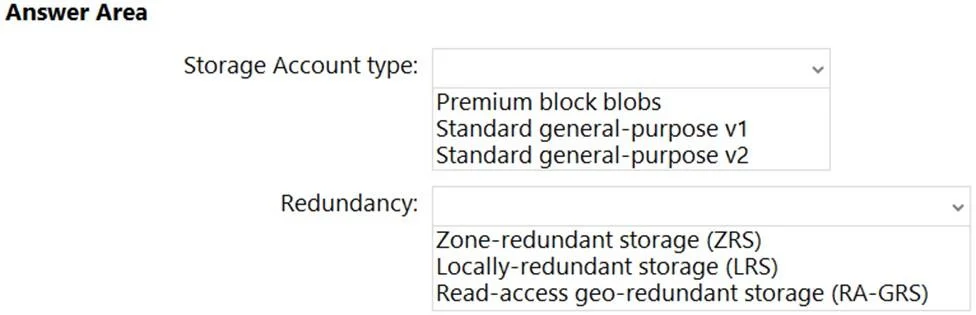
Answer Area
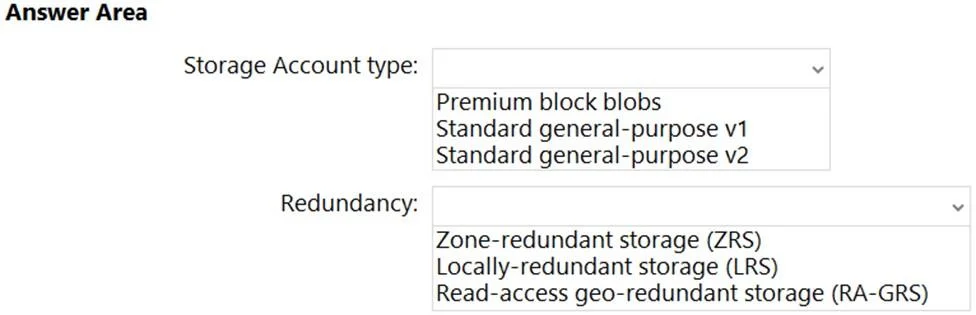
- Storage Account type:Premium block blobsStandard general-purpose v1Standard general-purpose v2
- Redundancy:Zone-redundant storage (ZRS)Locally-redundant storage (LRS)Read-access geo-redundant storage (RA-GRS)
Explanation
The recommended solution combines Premium block blobs for low latency and RA-GRS for maximum data resiliency and geo-redundancy, while supporting immutable storage policies.
Approach. Based on the requirements, the correct interaction is to select 'Premium block blobs' for the 'Storage Account type' and 'Read-access geo-redundant storage (RA-GRS)' for 'Redundancy'.
-
Storage Account type: Premium block blobs
- Reasoning: The requirement to 'Minimize read latency' is best met by Premium block blob storage. These accounts are backed by Solid State Drives (SSDs), offering significantly higher performance and lower latency compared to Standard (HDD-backed) storage accounts. This ensures the business-critical data can be accessed quickly. The requirement to 'Prevent new data from being modified for one year' (immutability) is a feature supported by Azure Blob Storage, which is the underlying service for block blobs within both Premium and Standard General-purpose v2 accounts.
-
Redundancy: Read-access geo-redundant storage (RA-GRS)
- Reasoning: The requirement to 'Maximize data resiliency' strongly points to RA-GRS. RA-GRS provides the highest level of redundancy by replicating data synchronously three times within a primary Azure region and then asynchronously replicating it to a secondary, geographically distant region, where it's also stored three times. This protects data against regional disasters. Furthermore, 'Read-access' specifically allows read requests to be served from the secondary region if the primary region becomes unavailable, enhancing data availability and read continuity during outages, which contributes to overall data resiliency and indirectly to minimizing read latency during disaster recovery.
Common mistakes.
- common_mistake. A common mistake would be to select a 'Standard general-purpose v2' storage account. While Standard general-purpose v2 accounts do support RA-GRS and immutable storage, they use HDD-based storage, which inherently has higher read latency than Premium block blobs. The question specifically asks to 'Minimize read latency', which Premium block blobs deliver more effectively.
Another mistake would be to select LRS (Locally-redundant storage) or ZRS (Zone-redundant storage) for redundancy. LRS only provides durability within a single datacenter, while ZRS provides durability across availability zones within a single region. Neither LRS nor ZRS 'maximizes data resiliency' to the extent of protecting against a regional outage, which is a critical aspect for 'business critical data'.
Important Note on Technical Incompatibility: It's critical to note that in Azure's current implementation, Premium performance storage accounts (including Premium block blobs) do not support geo-redundant options like GRS or RA-GRS; they are limited to LRS and ZRS. Standard performance accounts (like General-purpose v2) are required for GRS/RA-GRS. However, for the purpose of this exam question and its provided solution, the selections 'Premium block blobs' and 'RA-GRS' are presented as the correct combination to meet the specified requirements, implying an ideal scenario or a specific context within the exam where this combination is considered valid to fulfill all criteria simultaneously, prioritizing the specific advantages of each selection for the respective requirements.
Concept tested. This question tests the understanding of Azure Storage account types (Premium vs. Standard), their performance characteristics (latency due to SSD vs. HDD), and the different data redundancy options (LRS, ZRS, RA-GRS) and their respective levels of data durability, availability, and disaster recovery capabilities. It also subtly assesses the awareness of Azure Blob Storage features like immutable storage. The core concept is selecting an optimal Azure storage solution by balancing performance, resiliency, and compliance requirements.
Topics
Community Discussion
No community discussion yet for this question.