
AZ-305 · Question #122
Hotspot Question You are designing an application that will use Azure Linux virtual machines to analyze video files. The files will be uploaded from corporate offices that connect to Azure by using…
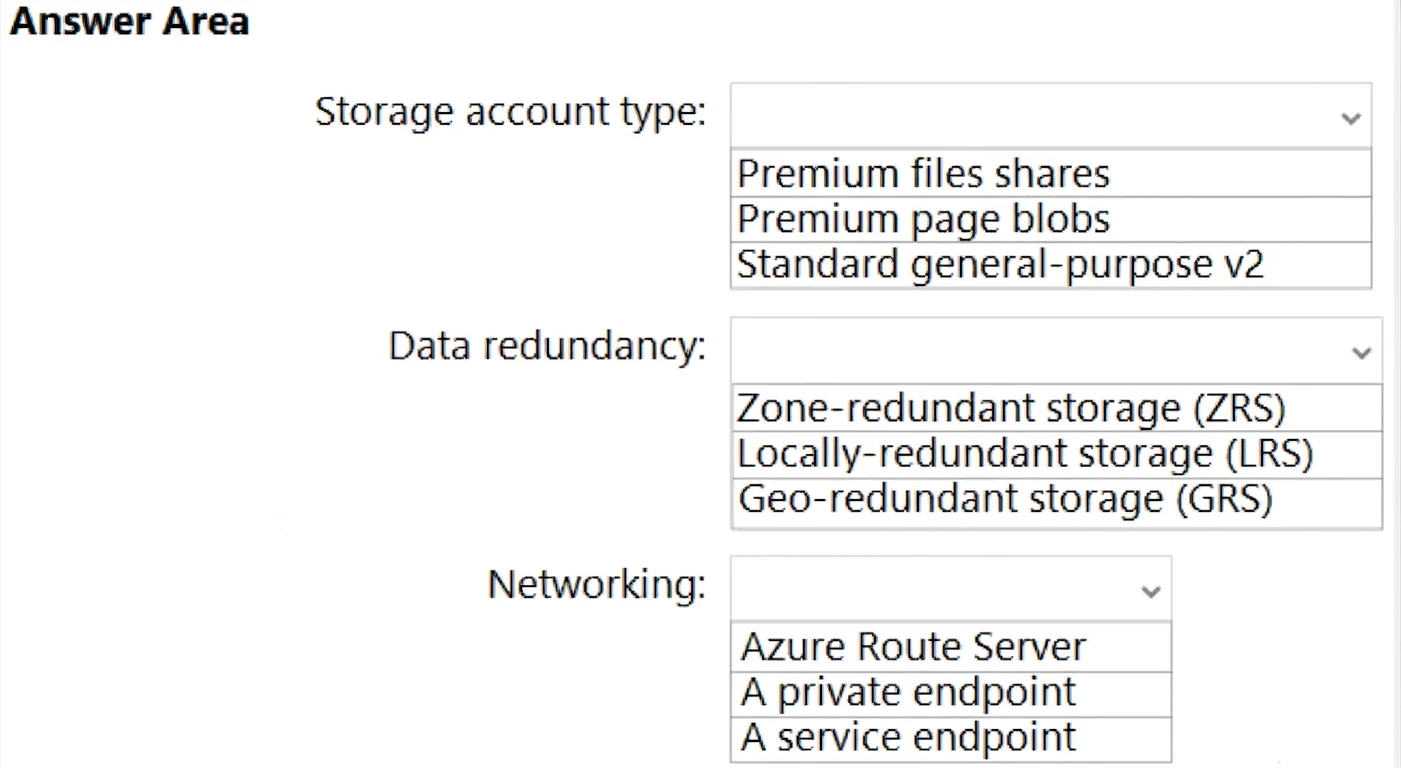
To meet the requirements for large video file storage, highest availability, and secure ExpressRoute upload, the storage account should be configured as Standard general-purpose v2 with Geo-redundant storage (GRS) and accessed via a private endpoint.
Question
Exhibit
Answer Area
- Storage account type:Premium files sharesPremium page blobsStandard general-purpose v2
- Data redundancy:Zone-redundant storage (ZRS)Locally-redundant storage (LRS)Geo-redundant storage (GRS)
- Networking:Azure Route ServerA private endpointA service endpoint
Explanation
To meet the requirements for large video file storage, highest availability, and secure ExpressRoute upload, the storage account should be configured as Standard general-purpose v2 with Geo-redundant storage (GRS) and accessed via a private endpoint.
Approach. To correctly configure the storage account, we must address each requirement outlined in the scenario:
-
Supports video files of up to 7 TB & Optimized for the large video files:
- Selection: Standard general-purpose v2
- Reasoning: Video files are typically stored as blobs. A
Standard general-purpose v2storage account supports block blobs, which are ideal for large unstructured data like video files. While individual block blobs have a size limit (currently up to ~4.75 TB), a GPv2 account can store up to 5 PB of data. The phrase 'up to 7 TB' likely refers to the aggregate capacity needed or the maximum size for a logical collection of files, or implies that individual files fit within typical block blob limits. Standard GPv2 is cost-effective and versatile for this use case. 'Premium page blobs' are primarily for VM disks (VHDs), and 'Premium files shares' are for SMB/NFS file shares, neither of which is suitable for general video file storage.
-
Provides the highest availability possible:
- Selection: Geo-redundant storage (GRS)
- Reasoning:
Geo-redundant storage (GRS)provides the highest level of availability and durability for Azure Storage. It replicates data three times within a primary region (LRS) and then asynchronously replicates it to a secondary region hundreds of miles away, protecting against region-wide outages.Zone-redundant storage (ZRS)protects against datacenter failures within a region, andLocally-redundant storage (LRS)protects against device failures within a single datacenter, neither offering the regional disaster recovery of GRS.
-
Ensures that files from the on-premises network are uploaded by using ExpressRoute:
- Selection: A private endpoint
- Reasoning: To ensure traffic from the on-premises network via ExpressRoute reaches the storage account privately and securely, a
private endpointis required. A private endpoint assigns a private IP address from your Azure Virtual Network to the storage account, allowing traffic to flow privately over your VNet and subsequently over the ExpressRoute connection from on-premises. This keeps all traffic on the private Microsoft backbone and your private network. 'A service endpoint' routes traffic over the Azure backbone but uses public IP addresses for the service endpoint itself, which is less private than a private endpoint. 'Azure Route Server' is for dynamic routing with NVAs, not for direct PaaS connectivity.
Common mistakes.
- common_mistake. Common mistakes include selecting 'Premium page blobs' or 'Premium files shares' for video storage, which are for different use cases. Choosing 'LRS' or 'ZRS' for data redundancy would fail to meet the 'highest availability possible' requirement. Selecting 'A service endpoint' instead of 'A private endpoint' for networking would not ensure fully private traffic over ExpressRoute, as service endpoints still utilize public IPs, even if optimized on the Azure backbone. For robust private connectivity from on-premises via ExpressRoute, private endpoints are the definitive solution.
Concept tested. Azure Storage account types (Standard general-purpose v2, Premium Page Blobs, Premium File Shares), Azure Storage data redundancy options (LRS, ZRS, GRS), and Azure private networking for PaaS services (Private Endpoints vs. Service Endpoints) in conjunction with ExpressRoute connectivity.
Reference. null
Topics
Community Discussion
No community discussion yet for this question.