
AZ-120 · Question #256
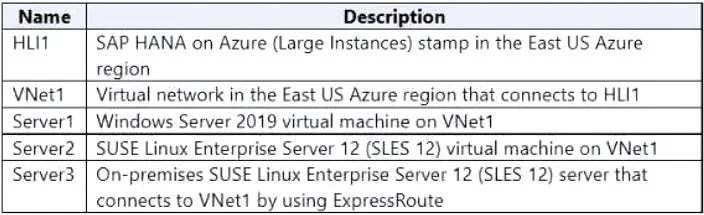
You have an Azure subscription that contains the resources shown in the following table. You need to download and install operating system updates from SUSE on HLI1. Which two actions should you…
The correct answer is C. Install and configure the SUSE Linux Subscription Management Tool on Server3. E. Install and configure the SUSE Linux Subscription Management Tool client on HLI1. Options C and E work together as a two-part solution: Server3 hosts the SUSE Subscription Management Tool (SMT) server, which acts as a local proxy to download updates from the SUSE Customer Center (requiring internet access and a compatible Linux OS), while HLI1 needs the SMT…
Question
You have an Azure subscription that contains the resources shown in the following table. You need to download and install operating system updates from SUSE on HLI1. Which two actions should you perform? Each correct answer presents part of the solution. NOTE: Each correct selection is worth one point.
Exhibit
Options
- AInstall and configure the SUSE Linux Subscription Management Tool on Server1.
- BInstall and configure the SUSE Linux Subscription Management Tool on Server2.
- CInstall and configure the SUSE Linux Subscription Management Tool on Server3.
- DInstall and configure the SUSE Linux Subscription Management Tool client on Server2.
- EInstall and configure the SUSE Linux Subscription Management Tool client on HLI1.
How the community answered
(64 responses)- A17% (11)
- B8% (5)
- C72% (46)
- D3% (2)
Explanation
Options C and E work together as a two-part solution: Server3 hosts the SUSE Subscription Management Tool (SMT) server, which acts as a local proxy to download updates from the SUSE Customer Center (requiring internet access and a compatible Linux OS), while HLI1 needs the SMT client installed so it can pull those downloaded updates from Server3 - because HANA Large Instances (HLI) have no direct outbound internet access.
Why the distractors are wrong:
- A (Server1) - Server1 is typically a Windows Server in these exam scenarios, which cannot run the SUSE SMT server tool
- B (Server2) - Server2 lacks the necessary characteristics (internet access or compatible OS) to act as the SMT server
- D (SMT client on Server2) - Server2 is not HLI1 and doesn't need SUSE updates; installing a client there solves nothing for HLI1
Memory tip: Think "Server → Client" flow. You need one server to fetch updates from SUSE (SMT server on Server3) and one client on the machine that actually needs the patches (SMT client on HLI1). The key exam signal is that HLIs are network-isolated, so they always require a proxy server inside the VNet - and that proxy must be Linux-compatible, ruling out Windows servers.
Topics
Community Discussion
No community discussion yet for this question.