
800-150 · Question #85
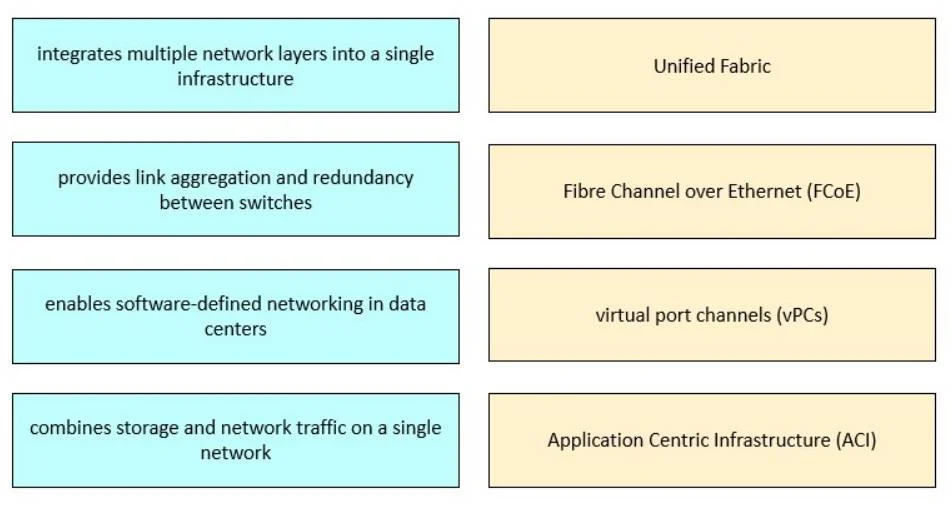
Drag and Drop Question Drag and drop the functions from the left onto the corresponding Cisco data center technologies on the right. Answer:
The correct answer is integrates multiple network layers into a single infrastructure; combines storage and network traffic on a single network; provides link aggregation and redundancy between switches; enables software-defined networking in data centers. Cisco Data Center Technologies - Drag-and-Drop Explained The right-side technologies (inferred from context, as is standard for this question format) are: | Position | Technology | Matched Function | |----------|-----------|-----------------| | 1 | Cisco Unified Fabric |…
Question
Drag and Drop Question Drag and drop the functions from the left onto the corresponding Cisco data center technologies on the right. Answer:
Exhibit
Answer Area
Drag items
Correct arrangement
- integrates multiple network layers into a single infrastructure
- combines storage and network traffic on a single network
- provides link aggregation and redundancy between switches
- enables software-defined networking in data centers
Explanation
Cisco Data Center Technologies - Drag-and-Drop Explained
The right-side technologies (inferred from context, as is standard for this question format) are:
| Position | Technology | Matched Function |
|---|---|---|
| 1 | Cisco Unified Fabric | integrates multiple network layers into a single infrastructure |
| 2 | FCoE (Fibre Channel over Ethernet) | combines storage and network traffic on a single network |
| 3 | vPC (Virtual Port Channel) | provides link aggregation and redundancy between switches |
| 4 | Cisco ACI (Application Centric Infrastructure) | enables software-defined networking in data centers |
Item-by-Item Breakdown
1. Unified Fabric → "integrates multiple network layers into a single infrastructure"
Cisco Unified Fabric collapses LAN, SAN, and management traffic into a single converged network fabric. The key word is multiple network layers - it is explicitly designed to unify what were previously separate physical infrastructures (compute, storage, networking) into one.
2. FCoE → "combines storage and network traffic on a single network"
FCoE (Fibre Channel over Ethernet) encapsulates Fibre Channel frames inside Ethernet frames, allowing traditional SAN (storage) traffic to ride alongside standard IP/Ethernet traffic on the same wire. The defining trait is storage + network on one cable, which directly maps to this description.
3. vPC → "provides link aggregation and redundancy between switches"
Virtual Port Channel lets two Cisco Nexus switches appear as a single logical switch to a downstream device, allowing active/active link aggregation (like LACP/PortChannel) across two physical switches. This eliminates STP-blocked ports and provides both redundancy and bandwidth aggregation - exactly what the description says.
4. ACI → "enables software-defined networking in data centers"
Cisco ACI (Application Centric Infrastructure) is Cisco's SDN solution for data centers, using an APIC controller to centrally manage policy, automate provisioning, and abstract physical infrastructure. SDN = centralized, programmable control - ACI is the answer whenever "software-defined" appears.
Common Mistakes
- Confusing Unified Fabric with FCoE: Both involve convergence, but Unified Fabric is the broader architecture, while FCoE is the specific protocol for carrying storage traffic over Ethernet. FCoE is a component within a Unified Fabric strategy.
- Confusing vPC with EtherChannel: Standard EtherChannel bundles links between one switch and one device. vPC specifically spans two switches, which is the data center redundancy differentiator.
- Assigning SDN to Unified Fabric: Unified Fabric is a hardware/topology concept; ACI is the programmability/SDN layer. Don't conflate infrastructure convergence with software-defined control.
Topics
Community Discussion
No community discussion yet for this question.