
800-150 · Question #86
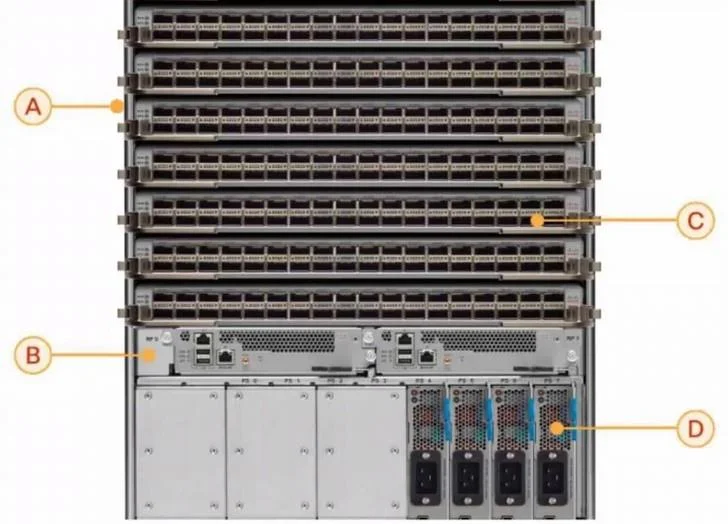
Drag and Drop Question Refer to the exhibit. Drag and drop the names of the field-replaceable units from the left onto the corresponding letters on the image of the Cisco NCS 5500 Series modular…
The correct answer is line cards; route processor cards; transceivers; power supplies. Cisco NCS 5500 Series: Component Identification The Cisco NCS 5500 is a modular chassis router. Each component type occupies a physically distinct and purpose-built slot/bay. Here's why each letter maps to its component: --- A → Line Cards Line cards are the most numerous…
Question
Drag and Drop Question Refer to the exhibit. Drag and drop the names of the field-replaceable units from the left onto the corresponding letters on the image of the Cisco NCS 5500 Series modular router. Answer:
Exhibit
Answer Area
Drag items
Correct arrangement
- line cards
- route processor cards
- transceivers
- power supplies
Explanation
Cisco NCS 5500 Series: Component Identification
The Cisco NCS 5500 is a modular chassis router. Each component type occupies a physically distinct and purpose-built slot/bay. Here's why each letter maps to its component:
A → Line Cards
Line cards are the most numerous modules and occupy the main forwarding slots - the large, horizontal bays that dominate the front face of the chassis. They contain NPUs (Network Processing Units) and port interfaces, handling all packet forwarding. Because they make up the bulk of the chassis real estate, they're the most visually prominent element.
Common mistake: Confusing line card slots with RP slots - line card slots are more numerous and lack management interfaces.
B → Route Processor Cards
Route processor (RP) cards sit in dedicated, labeled RP slots - typically fewer slots positioned separately from line card bays (often toward the top or center spine of the chassis). They run the control plane (IOS XR OS), manage routing protocols, and control the fabric.
Common mistake: Thinking RPs are interchangeable with line cards. They are not - RP slots are distinct and the chassis will not boot without one.
C → Transceivers
Transceivers (SFP, SFP+, QSFP28, etc.) are plugged into the port cages on the face of the line cards - they are the smallest components and are visible as individual port-sized modules. They define the physical medium (fiber, copper, DAC).
Common mistake: Treating transceivers as a chassis-level component. They are sub-components of line cards, not independent slots.
D → Power Supplies
Power supplies occupy dedicated bays at the bottom (or side) of the chassis, separate from all card slots. NCS 5500 supports AC/DC power modules in a N+1 or N+N redundancy configuration.
Common mistake: Confusing power supply bays with fan trays, which also sit in dedicated bays but are typically at the rear.
Summary Table
| Letter | Component | Location in Chassis | Function |
|---|---|---|---|
| A | Line cards | Main card slots (front, majority) | Data plane / packet forwarding |
| B | Route processor cards | Dedicated RP slots | Control plane / OS |
| C | Transceivers | Port cages on line cards | Physical layer connectivity |
| D | Power supplies | Bottom/side bays | Chassis power delivery |
The key insight: form follows function - the largest, most numerous components (line cards) take the most space; the management brain (RP) is isolated; transceivers are port-level, not chassis-level; power is always in its own segregated bay.
Topics
Community Discussion
No community discussion yet for this question.