
800-150 · Question #88
Drag and Drop Question Drag and drop the characteristics from the left onto the corresponding categories of MDS switch on the right. Answer:
The correct answer is scalable and expandable design; enterprise-class performance; high port densities; suitable for small deployments; fixed number of ports; ideal for Edge SAN deployments. MDS Switch Categories: Drag-and-Drop Explained This question maps 6 characteristics across two categories of Cisco MDS switches: | Category | Characteristics (items 1–3) | |---|---| | MDS Director-class (Modular) | 1, 2, 3 | | MDS Fabric Switch (Fixed) | 4, 5, 6 |…
Question
Drag and Drop Question Drag and drop the characteristics from the left onto the corresponding categories of MDS switch on the right. Answer:
Exhibit
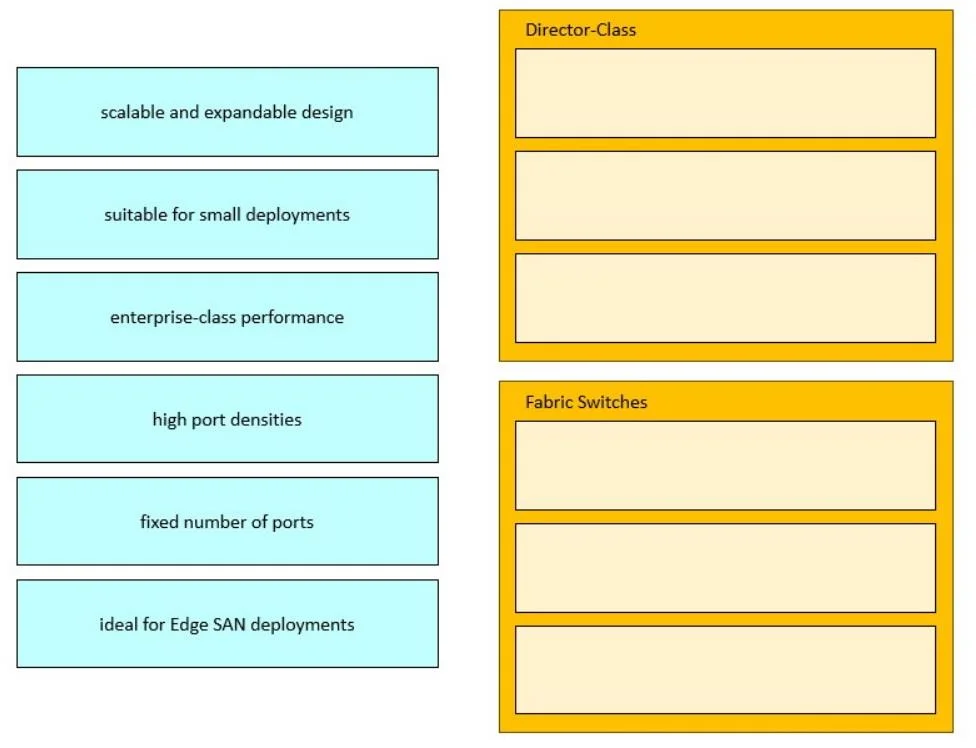
Answer Area
Drag items
Correct arrangement
- scalable and expandable design
- enterprise-class performance
- high port densities
- suitable for small deployments
- fixed number of ports
- ideal for Edge SAN deployments
Explanation
MDS Switch Categories: Drag-and-Drop Explained
This question maps 6 characteristics across two categories of Cisco MDS switches:
| Category | Characteristics (items 1–3) |
|---|---|
| MDS Director-class (Modular) | 1, 2, 3 |
| MDS Fabric Switch (Fixed) | 4, 5, 6 |
Director-Class (Modular) Switches - Items 1, 2, 3
1. Scalable and expandable design Directors use a modular chassis with swappable line cards and supervisor modules. You add capacity by inserting blades - the switch grows with your needs.
2. Enterprise-class performance Directors (e.g., MDS 9700) are built for core/aggregation layers - non-blocking fabrics, high availability with redundant supervisors and power supplies, and carrier-grade uptime requirements.
3. High port densities Because of the modular design, directors can scale to hundreds of Fibre Channel ports in a single chassis, making them suitable for large data center cores.
Fabric Switches (Fixed) - Items 4, 5, 6
4. Suitable for small deployments Fixed-port switches (e.g., MDS 9100/9200 series) have a lower entry cost and smaller footprint, making them practical where only a limited number of SAN ports are needed.
5. Fixed number of ports No expansion slots - what you buy is what you get. This is the defining hardware trait of this category.
6. Ideal for Edge SAN deployments "Edge" means the access layer closest to servers/hosts. Fixed switches sit here, connecting hosts to the SAN fabric without needing the scale of a director.
Common Mistakes
- Confusing "high port density" with fixed switches - fixed switches can have many ports on paper, but they don't scale. "High port density" in SAN context refers to the scalable capacity of directors.
- Assuming "enterprise-class" applies to all MDS - Cisco markets the entire MDS line as enterprise-grade, but in exam context this phrase specifically distinguishes director-class capabilities (redundancy, non-blocking, HA) from basic fabric switches.
- Misplacing "Edge SAN" - Edge = access layer = fixed/smaller switches, not the core director layer.
Topics
Community Discussion
No community discussion yet for this question.