800-150 · Question #69
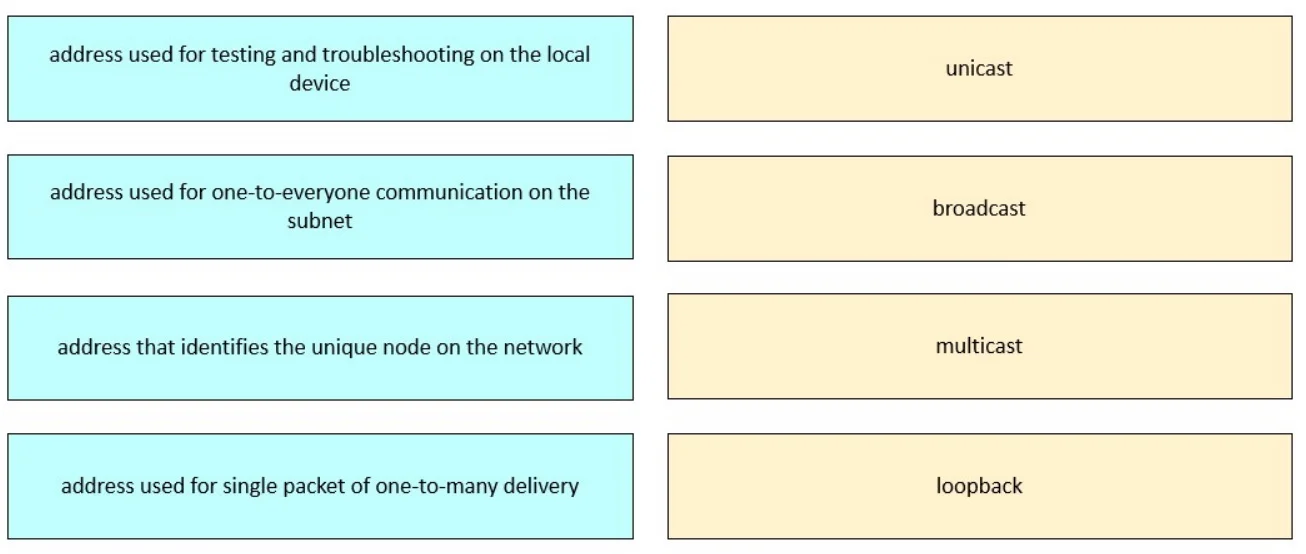
Drag and Drop Question Drag and drop the descriptions from the left onto the corresponding IPv4 addressing modes on the right. Answer:
The correct answer is address that identifies the unique node on the network; address used for one-to-everyone communication on the subnet; address used for single packet of one-to-many delivery; address used for testing and troubleshooting on the local device. IPv4 Addressing Modes - Drag & Drop Explained The four positions correspond to these IPv4 addressing modes (in order): Unicast → Broadcast → Multicast → Loopback --- The Correct Matches 1. Unicast → "address that identifies the unique node on the network" Unicast is a…
Question
Drag and Drop Question Drag and drop the descriptions from the left onto the corresponding IPv4 addressing modes on the right. Answer:
Exhibit
Answer Area
Drag items
Correct arrangement
- address that identifies the unique node on the network
- address used for one-to-everyone communication on the subnet
- address used for single packet of one-to-many delivery
- address used for testing and troubleshooting on the local device
Explanation
IPv4 Addressing Modes - Drag & Drop Explained
The four positions correspond to these IPv4 addressing modes (in order): Unicast → Broadcast → Multicast → Loopback
The Correct Matches
1. Unicast → "address that identifies the unique node on the network"
Unicast is a one-to-one delivery model. Every device on a network has a unique unicast IP address (e.g., 192.168.1.10). When you send a packet to that address, it goes to exactly one destination. "Unique node" is the key phrase - unicast literally means one specific interface.
2. Broadcast → "address used for one-to-everyone communication on the subnet"
Broadcast sends a packet to all devices on the local subnet simultaneously. The broadcast address is always the last address in a subnet (e.g., 192.168.1.255). "One-to-everyone on the subnet" is the defining characteristic - broadcasts don't cross routers by default.
3. Multicast → "address used for single packet of one-to-many delivery"
Multicast sends one packet to a select group of interested receivers (not everyone). Multicast addresses are in the 224.0.0.0–239.255.255.255 range. The phrase "single packet of one-to-many" captures this efficiency - one transmission reaches multiple subscribers without flooding all hosts.
4. Loopback → "address used for testing and troubleshooting on the local device"
The loopback address (127.0.0.1, or the entire 127.0.0.0/8 block) never leaves the local machine. It's used to test the TCP/IP stack and network software on the device itself. "Testing and troubleshooting on the local device" is its sole purpose.
Common Mistakes & Misconceptions
| Mistake | Why It's Wrong |
|---|---|
| Confusing multicast with broadcast | Broadcast hits everyone on the subnet; multicast hits only subscribed members |
| Thinking loopback is for remote diagnostics | Loopback traffic never leaves the host - it's purely local self-testing |
| Assuming multicast uses multiple packets | Multicast's efficiency gain is that one packet is replicated by routers/switches, not the sender |
| Confusing "unique node" with loopback | Loopback is unique but not a network-reachable identity - unicast is the routable unique address |
The core pattern to remember: Unicast = 1:1 | Broadcast = 1:all | Multicast = 1:many (group) | Loopback = self-test
Topics
Community Discussion
No community discussion yet for this question.
