
70-243 · Question #45
Note: This question is part of a series of questions that use the same set of answer choices. An answer choice may be correct for more than one question in the series. Your network contains a System…
No correct answer was provided for this question. Based on the scenario, remote computers blocked from direct internal network communication require a management point installed in an accessible perimeter location to enable inventory collection.
Question
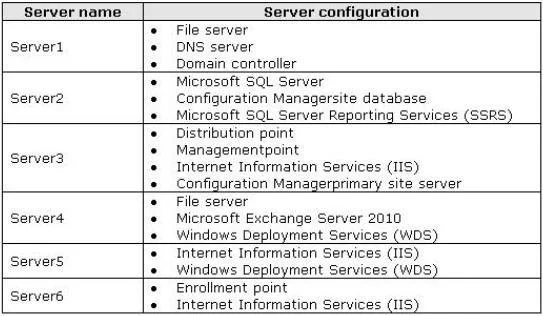
Note: This question is part of a series of questions that use the same set of answer choices. An answer choice may be correct for more than one question in the series. Your network contains a System Center 2012 Configuration Manager environment as shown in the exhibit. (Click the Exhibit button.) The network contains six servers. The servers are configured as shown in the following table. A corporate security policy states that remote computers are forbidden to communicate directly with servers on the internal network. You need to ensure that you collect inventory data from the remote computers. What should you do?
Exhibit
Options
- AInstall Windows Server Update Serves (WSUS) on Server3.
- BConfigure the Exchange connector on Server3.
- CInstall a management point on Server2.
- DInstall a PXE-enabled protected distribution point on Servers.
- EInstall a software update point on Server3.
- FInstall Network Load Balancing (NLB) on Server6.
- GInstall an enrollment proxy point on Server6.
- HInstall the Windows Cluster service on Server3.
- IInstall a protected distribution point on Server1.
- JConfigure IIS to support only HTTPS on Servers.
Why each option
No correct answer was provided for this question. Based on the scenario, remote computers blocked from direct internal network communication require a management point installed in an accessible perimeter location to enable inventory collection.
WSUS handles software update catalog synchronization between servers and does not provide a communication path for remote clients to submit inventory data.
The Exchange connector manages mobile device enrollment and policy via Exchange ActiveSync and has no role in collecting PC inventory from remote computers.
A PXE-enabled distribution point facilitates OS deployment via network boot and does not address the requirement to collect inventory from already-running remote client computers.
A software update point provides Windows Update services to clients but does not create a channel through which remote clients can submit inventory data to the site.
Network Load Balancing distributes traffic across multiple servers for availability but does not by itself resolve the network boundary restriction preventing remote clients from reaching internal site systems.
An enrollment proxy point is used to enroll mobile devices and Mac computers via SCCM and is not applicable to Windows PC inventory collection.
Windows Clustering provides high availability failover for services but does not establish the network accessibility needed for remote clients blocked from internal servers.
A protected distribution point restricts which boundaries can access content for deployment but does not provide a communication endpoint for remote clients to submit inventory.
Enforcing HTTPS-only on IIS improves transport security but does not resolve the fundamental network boundary issue blocking remote clients from reaching internal site system roles.
Concept tested: SCCM management point placement for remote client inventory collection
Source: https://learn.microsoft.com/en-us/mem/configmgr/core/plan-design/hierarchy/plan-for-site-system-servers-and-site-system-roles
Topics
Community Discussion
No community discussion yet for this question.