
400-007 · Question #160
Refer to the exhibit. This network is running legacy STP 802.1d. Assuming "hello_timer" is fixed to 2 seconds, which parameters can be modified to speed up convergence times after single link/node…
The correct answer is C. The max_age and forward delay parameters can be adjusted to speed up STP convergence. In IEEE 802.1d STP, the max_age and forward_delay timers are the adjustable parameters that directly control failure detection speed and port state transition time, allowing faster convergence after a link or node failure.
Question
Refer to the exhibit. This network is running legacy STP 802.1d. Assuming "hello_timer" is fixed to 2 seconds, which parameters can be modified to speed up convergence times after single link/node failure?
Exhibit
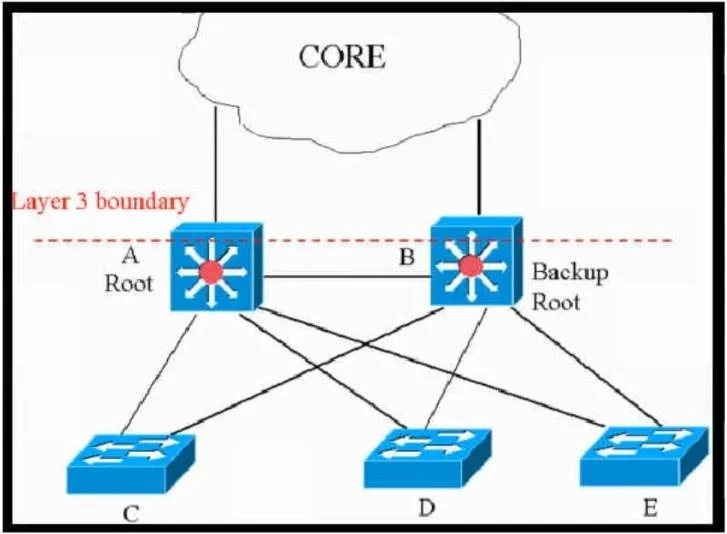
Options
- AThe transit_delay=5 and dpdu_delay=20 are recommended values, considering helto_timer=2
- BOnly the maximum_transmission_halt_delay and diameter parameters are configurable
- CThe max_age and forward delay parameters can be adjusted to speed up STP convergence
- DOnly the transit_delay and bpdu_delay timers are configurable parameters in 802.1d to speed up
How the community answered
(36 responses)- A6% (2)
- B3% (1)
- C92% (33)
Why each option
In IEEE 802.1d STP, the max_age and forward_delay timers are the adjustable parameters that directly control failure detection speed and port state transition time, allowing faster convergence after a link or node failure.
transit_delay and dpdu_delay (bpdu_delay) are not recognized 802.1d STP timer parameters, and the values cited do not map to any valid STP convergence configuration.
maximum_transmission_halt_delay is not a standard 802.1d STP parameter; network diameter is a design input used to calculate recommended timer values rather than a directly configurable convergence timer.
Reducing max_age (default 20 s) shortens how long a non-root bridge waits before declaring a superior BPDU lost and initiating a new topology calculation, accelerating failure detection. Reducing forward_delay (default 15 s) decreases the time ports spend in the Listening and Learning states before transitioning to Forwarding, directly cutting the total reconvergence time after a topology change event.
transit_delay and bpdu_delay are not standard IEEE 802.1d STP configurable timer names; the correct convergence timers are max_age and forward_delay.
Concept tested: IEEE 802.1d STP convergence timer tuning
Source: https://www.cisco.com/c/en/us/support/docs/lan-switching/spanning-tree-protocol/19120-122.html
Topics
Community Discussion
No community discussion yet for this question.