
400-007 · Question #159
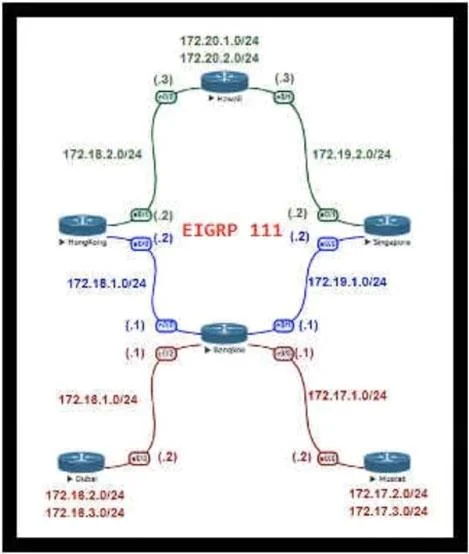
Refer to the exhibit. For Company XYZ Bangkok is using ECMP to reach the 172.20.2.0/24 network. The company wants a design that would allow them to forward traffic from 172.16.2.0/24 toward…
The correct answer is A. policy-based routing. Policy-based routing (PBR) enables source-address-based forwarding decisions, allowing traffic from 172.16.2.0/24 to be steered toward the Singapore next hop while all other traffic continues using the existing ECMP paths.
Question
Refer to the exhibit. For Company XYZ Bangkok is using ECMP to reach the 172.20.2.0/24 network. The company wants a design that would allow them to forward traffic from 172.16.2.0/24 toward 172.20.2.0/24 via the Singapore router as the preferred route. The rest of the traffic should continue to use ECMP. Which technology fulfills this design requirement?
Exhibit
Options
- Apolicy-based routing
- Broute summarization
- Cunequal-cost load balancing using variance
- DLFA
How the community answered
(42 responses)- A74% (31)
- B5% (2)
- C7% (3)
- D14% (6)
Why each option
Policy-based routing (PBR) enables source-address-based forwarding decisions, allowing traffic from 172.16.2.0/24 to be steered toward the Singapore next hop while all other traffic continues using the existing ECMP paths.
PBR uses route maps applied to an interface to match packets by source address via an ACL and then sets a specific next hop, overriding the normal routing table lookup only for matched traffic. Because PBR operates per-packet before the FIB is consulted for matched flows, traffic from 172.16.2.0/24 is forwarded via Singapore while unmatched traffic falls through to the existing ECMP routing table entries.
Route summarization aggregates destination prefixes in the routing table and has no mechanism to differentiate forwarding based on source IP address.
Unequal-cost load balancing via variance distributes traffic proportionally across multiple paths based on metric ratios but cannot match and steer traffic by source address to a preferred next hop.
LFA pre-computes backup next hops for fast reroute during link or node failures and does not provide source-address-based traffic engineering for normal forwarding.
Concept tested: Policy-based routing for source-address traffic steering
Source: https://www.cisco.com/c/en/us/td/docs/ios-xml/ios/iproute_pi/configuration/xe-16/iri-xe-16-book/iri-policy-route-maps.html
Topics
Community Discussion
No community discussion yet for this question.