
350-401 · Question #787
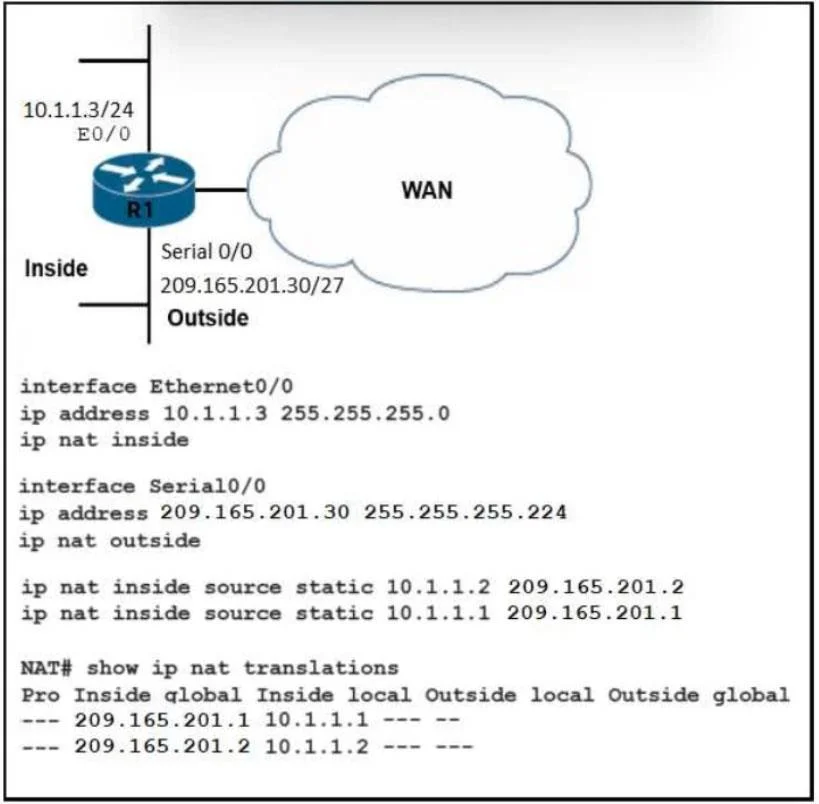
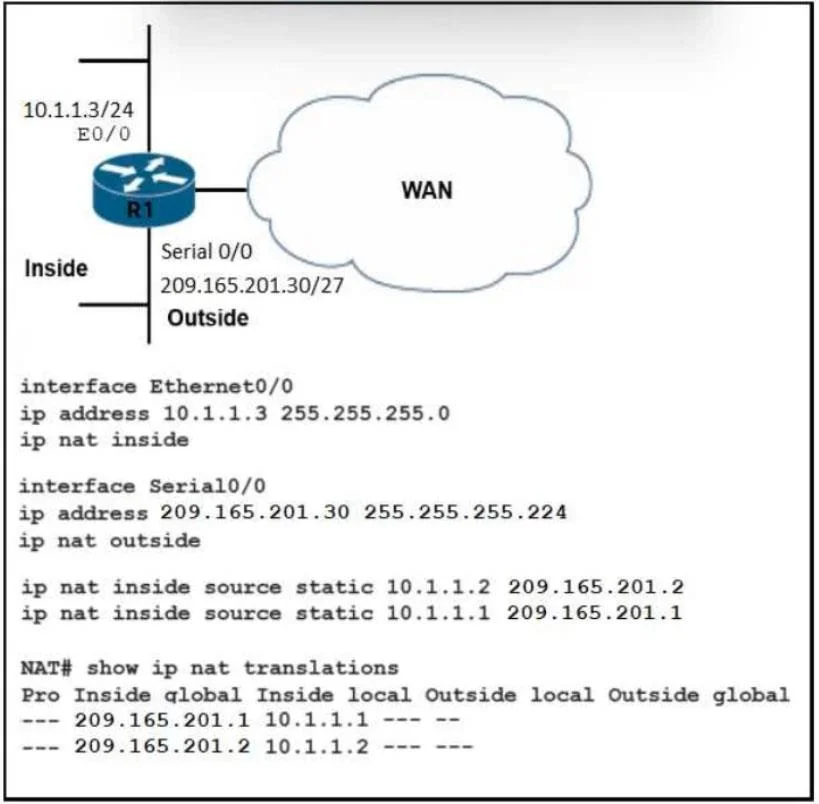
Refer to the exhibit. What are two results of the NAT configuration? (Choose two.)
The correct answer is B. A packet that is sent to 200.1.1.1 from 10.1.1.1 is translated to 209.165.201.1 on R1. C. R1 looks at the destination IP address of packets entering S0/0 and destined for inside hosts. NAT configuration involves translating source IP addresses for outbound traffic from inside hosts and translating destination IP addresses for inbound traffic directed to inside hosts.
Question
Exhibits
Options
- APackets with a destination of 200.1.1.1 are translated to 10.1.1.1 or .2, respectively.
- BA packet that is sent to 200.1.1.1 from 10.1.1.1 is translated to 209.165.201.1 on R1.
- CR1 looks at the destination IP address of packets entering S0/0 and destined for inside hosts.
- DR1 processes packets entering E0/0 and S0/0 by examining the source IP address.
- ER1 is performing NAT for inside addresses and outside address.
How the community answered
(32 responses)- A6% (2)
- B81% (26)
- D3% (1)
- E9% (3)
Why each option
NAT configuration involves translating source IP addresses for outbound traffic from inside hosts and translating destination IP addresses for inbound traffic directed to inside hosts.
While a NAT rule might translate 200.1.1.1 to 10.1.1.1, the 'or .2, respectively' part implies a specific configuration not necessarily generic, and it's a specific instance of destination NAT which C covers generally.
This statement describes the function of `ip nat inside source static` or `ip nat inside source list` when an inside host (10.1.1.1) initiates communication, causing its source IP address to be translated to a public IP (209.165.201.1) as it leaves the router.
For inbound traffic destined for inside hosts that have been published through NAT, R1, acting as an `ip nat outside` interface (S0/0), must inspect the destination IP address of incoming packets to perform the necessary destination translation to the actual inside host.
For packets entering E0/0 (inside), R1 examines the source IP, but for packets entering S0/0 (outside), it primarily examines the *destination IP* for NAT rules that translate to inside hosts, making the statement partially incorrect.
Concept tested: Static NAT behavior (inside source static, outside source static, packet flow)
Source: https://www.cisco.com/c/en/us/td/docs/ios-xml/ios/ipaddr_nat/configuration/15-mt/iad-nat-15-mt-book/iad-cfg-nat-static.html
Topics
Community Discussion
No community discussion yet for this question.