
350-401 · Question #577
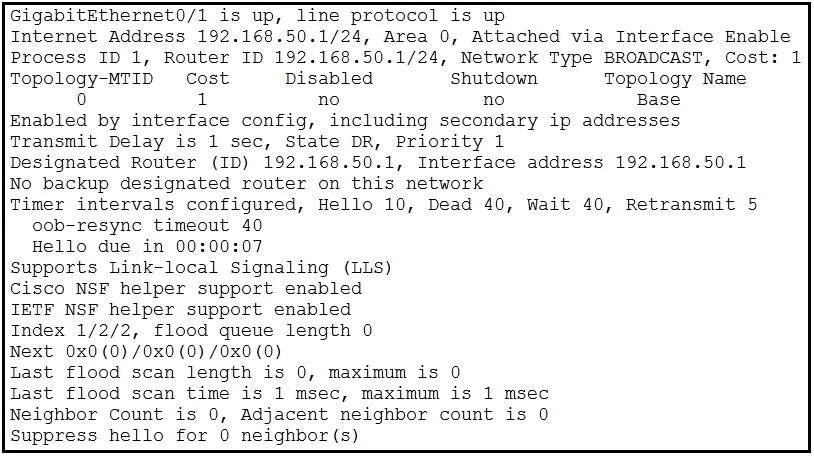
Refer to the exhibit. An engineer configures OSPF and wants to verify the configuration. Which configuration is applied to this device?
The correct answer is C. R1(config)#interface Gi0/1. The question, despite lacking an exhibit, asks which configuration command is applied for OSPF. The interface Gi0/1 command enters the specific interface configuration mode where OSPF settings can be directly applied.
Question
Exhibits
Options
- AR1(config)#interface Gi0/1
- BR1(config)#router ospf 1
- CR1(config)#interface Gi0/1
- DR1(config)#router ospf 1
How the community answered
(28 responses)- A4% (1)
- B7% (2)
- C89% (25)
Why each option
The question, despite lacking an exhibit, asks which configuration command is applied for OSPF. The `interface Gi0/1` command enters the specific interface configuration mode where OSPF settings can be directly applied.
This option is identical to C, and typically in a multiple-choice question, distinct options are expected. If C is correct, A would also technically be correct due to redundancy.
The `router ospf 1` command enters the OSPF routing process configuration mode, which is used for global OSPF settings like router ID and network commands, but not for direct interface-specific OSPF parameters like `ip ospf area`.
The `interface Gi0/1` command enters the specific interface configuration mode where settings such as OSPF area assignment can be directly applied to the interface, rather than globally via the OSPF routing process. This command is the first step to apply interface-specific OSPF configurations.
The `router ospf 1` command enters the OSPF routing process configuration mode, which is used for global OSPF settings like router ID and network commands, but not for direct interface-specific OSPF parameters like `ip ospf area`.
Concept tested: OSPF interface configuration context
Source: https://www.cisco.com/c/en/us/td/docs/ios-xml/ios/iproute_ospf/configuration/15-mt/iro-15-mt-book/iro-cfg.html
Topics
Community Discussion
No community discussion yet for this question.