
350-401 · Question #453
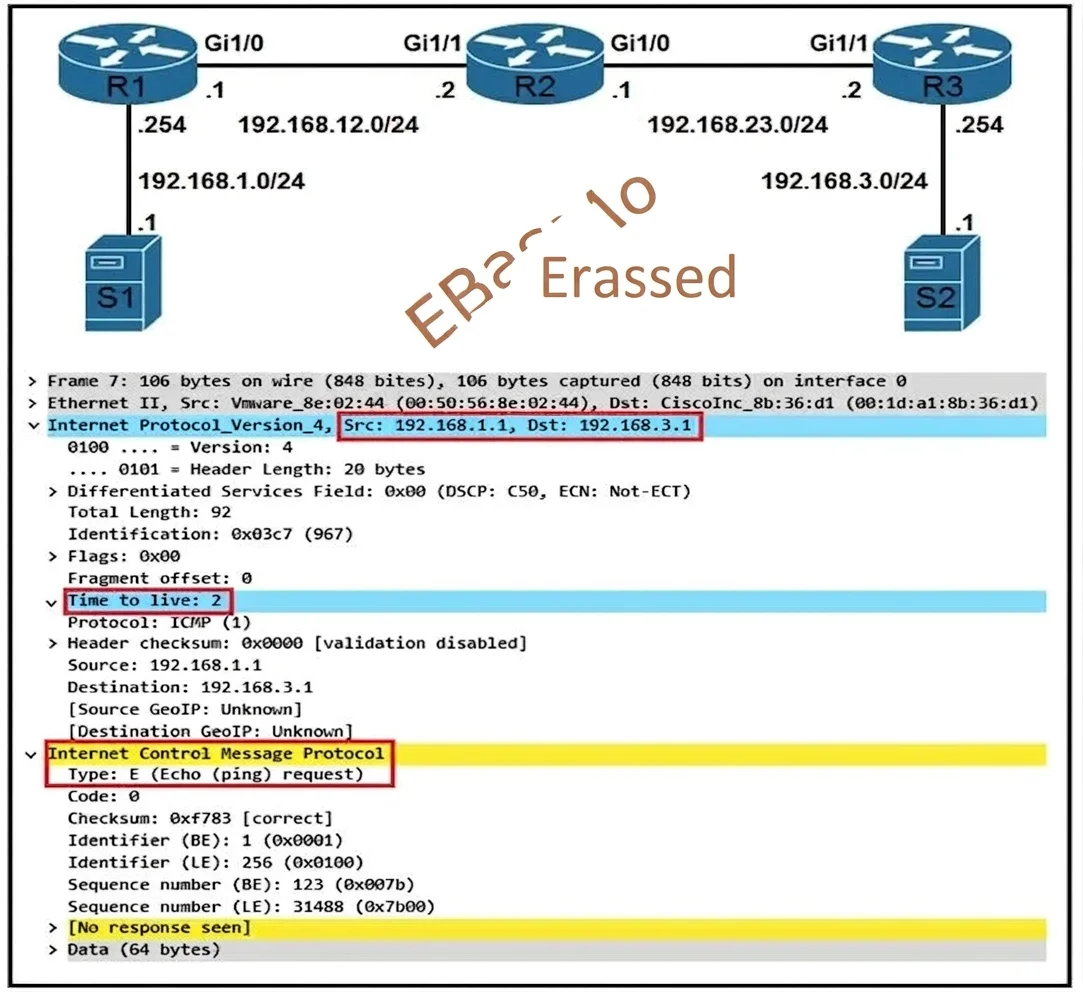
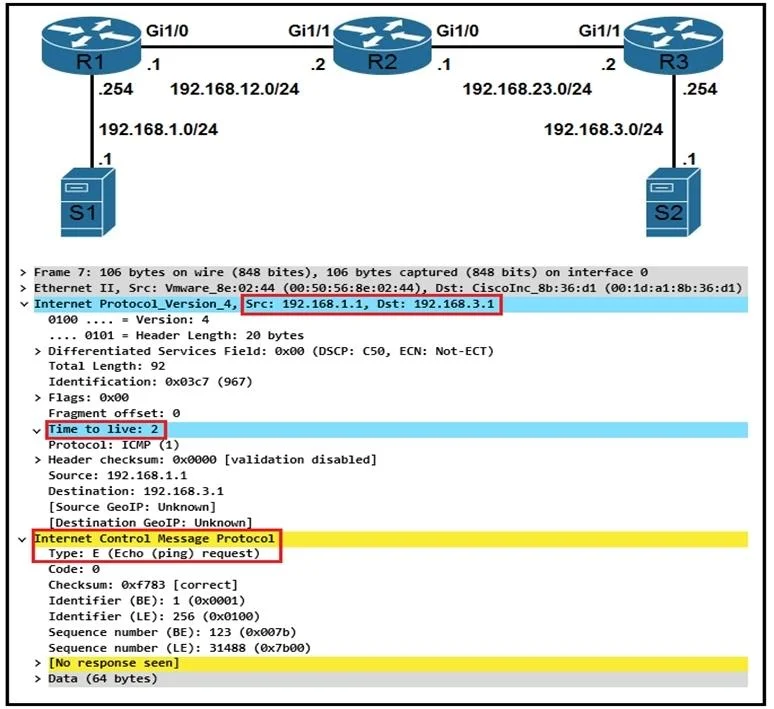
Refer to the exhibit. Which troubleshooting a routing issue, an engineer issues a ping from S1 to S2. When two actions from the initial value of the TTL? (Choose two.)
The correct answer is B. R2 replies with a TTL exceeded message D. The packet reaches R2 and the TTL expires. TTL Expiration and ICMP "Time Exceeded" Messages When a ping is sent from S1 to S2, the packet travels through R1, R2, and R3. Based on the network topology implied by the exhibit, the packet's TTL decrements by 1 at each router hop, and the TTL reaches zero at R2 (Option D)…
Question
Exhibits
Options
- AThe packet reaches R3 and the TTL expires
- BR2 replies with a TTL exceeded message
- CR3 replies with a TTL exceeded message.
- DThe packet reaches R2 and the TTL expires
- ER1 replies with a TTL exceeded message
- FThe packet reaches R1 and the TTL expires.
How the community answered
(32 responses)- A6% (2)
- B78% (25)
- C3% (1)
- F13% (4)
Explanation
TTL Expiration and ICMP "Time Exceeded" Messages
When a ping is sent from S1 to S2, the packet travels through R1, R2, and R3. Based on the network topology implied by the exhibit, the packet's TTL decrements by 1 at each router hop, and the TTL reaches zero at R2 (Option D), meaning the packet expires there - not at R1 or R3. When R2 drops the packet due to TTL expiration, R2 is the router that sends the "TTL Exceeded" ICMP message back to the source (Option B) - this is standard router behavior per RFC 792.
Why the distractors are wrong:
- A & C: The packet never reaches R3 because TTL expires before that point.
- E & F: The packet successfully passes through R1 (TTL is still valid there), so R1 neither drops the packet nor sends a TTL exceeded message.
Memory Tip: Think of TTL like a countdown timer - the router that hits zero DROPS the packet AND sends the "Time Exceeded" message. It's always a two-part action at the same router: expiry + notification. If the question asks for two answers, look for the router where TTL hits zero AND that router's reply message.
Topics
Community Discussion
No community discussion yet for this question.