
350-401 · Question #230
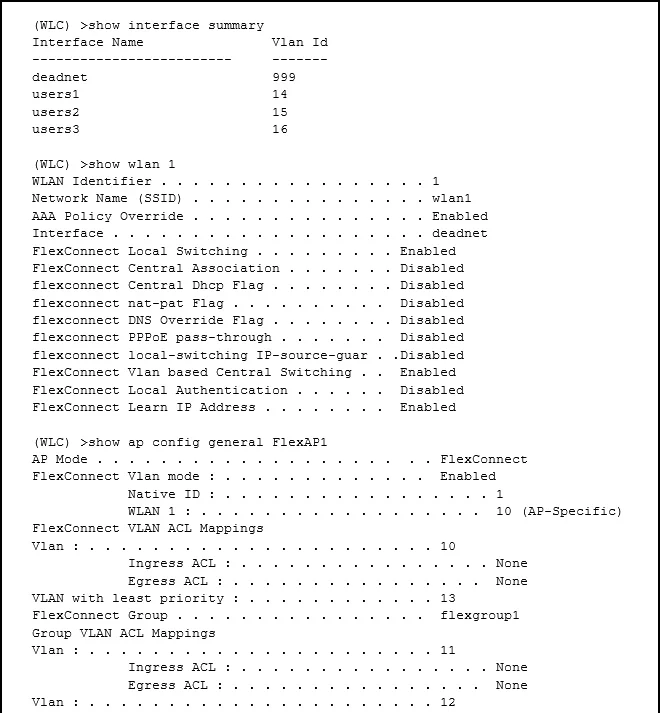
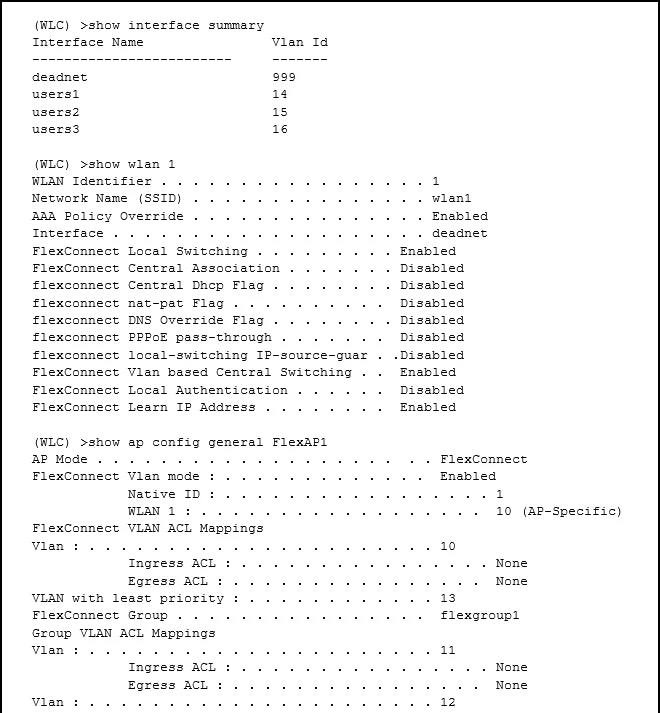
Refer to the exhibit. A wireless client is connecting to FlexAP1 which is currently working standalone mode. The AAA authentication processis returning the following AVPs…
The correct answer is B. While the AP is in standalone mode, the client will be placed in VLAN 10. C. When the AP transitions to connected mode, the client will be de-authenticated. G. When the AP is in connected mode, the client will be placed in VLAN 15. FlexConnect Standalone Mode & AAA VLAN Assignment In FlexConnect standalone mode, the AP cannot process dynamic VLAN assignments from AAA/RADIUS AVPs, so it falls back to the locally configured VLAN on the AP (VLAN 10 in the exhibit) - making B correct. When the AP transitions…
Question
Refer to the exhibit. A wireless client is connecting to FlexAP1 which is currently working standalone mode. The AAA authentication processis returning the following AVPs:
Tunnel-Private-Group-Id(81): 15 Tunnel-Medium-Type(65): IEEE-802(6) Tunnel-Type(64): VLAN(13) Which three behaviors will the client experience? (Choose three.)
Exhibits
Options
- AWhile the AP is in standalone mode, the client will be placed in VLAN 15.
- BWhile the AP is in standalone mode, the client will be placed in VLAN 10.
- CWhen the AP transitions to connected mode, the client will be de-authenticated.
- DWhile the AP is in standalone mode, the client will be placed in VLAN 13.
- EWhen the AP is in connected mode, the client will be placed in VLAN 13.
- FWhen the AP transitions to connected mode, the client will remain associated.
- GWhen the AP is in connected mode, the client will be placed in VLAN 15.
- HWhen the AP is in connected mode, the client will be placed in VLAN 10.
How the community answered
(28 responses)- B79% (22)
- D11% (3)
- F4% (1)
- H7% (2)
Explanation
FlexConnect Standalone Mode & AAA VLAN Assignment
In FlexConnect standalone mode, the AP cannot process dynamic VLAN assignments from AAA/RADIUS AVPs, so it falls back to the locally configured VLAN on the AP (VLAN 10 in the exhibit) - making B correct. When the AP transitions back to connected mode, it re-authenticates clients through the WLC, which can process the RADIUS AVPs and assigns the client to the dynamic VLAN 15 (Tunnel-Private-Group-Id = 15) - making G correct. Because the VLAN changes between standalone and connected mode, the client must be de-authenticated and re-associated during the transition - making C correct.
Why distractors are wrong:
- A & D are wrong because standalone FlexConnect APs ignore dynamic AAA VLAN attributes and use the locally mapped VLAN, not VLAN 15 or 13
- E is wrong because VLAN 13 is the Tunnel-Type value (indicating the type is VLAN), not the VLAN ID itself
- F is wrong because the VLAN change forces de-authentication, not seamless continuity
- H is wrong because in connected mode the WLC processes the AAA response and assigns VLAN 15, not VLAN 10
Memory Tip: Think "Standalone = Static, Connected = Dynamic" - FlexConnect APs in standalone mode use locally configured VLANs, while connected mode enables WLC-driven dynamic VLAN assignment from RADIUS attributes.
Topics
Community Discussion
No community discussion yet for this question.