
350-401 · Question #1293
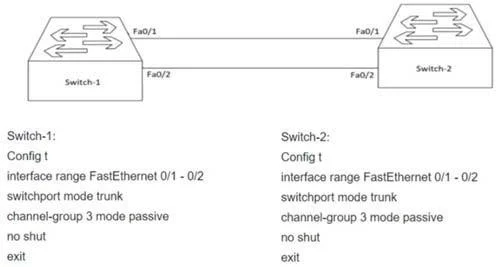
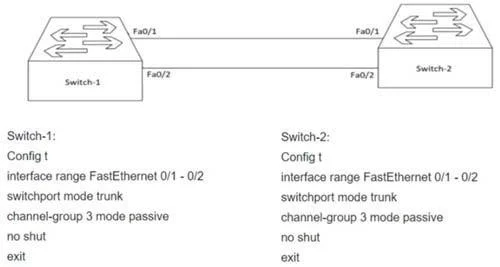
Refer to the exhibit. An LACP port channel is configured between Switch-1 and Switch-2, but it fails to come up. Which action will resolve the issue?
The correct answer is A. Configure Switch-1 with channel-group mode active. To establish an LACP port channel, at least one side must be configured in active mode to actively negotiate, as passive mode waits for the other side to initiate.
Question
Exhibits
Options
- AConfigure Switch-1 with channel-group mode active
- BConfigure Switch-1 with channel-group mode on
- CConfigure Switch-2 with channel-group mode auto
- DConfigure Switch-2 with channel-group mode desirable .
How the community answered
(26 responses)- A50% (13)
- B27% (7)
- C15% (4)
- D8% (2)
Why each option
To establish an LACP port channel, at least one side must be configured in `active` mode to actively negotiate, as `passive` mode waits for the other side to initiate.
LACP requires at least one side to be in `active` mode to initiate the negotiation process. If both Switch-1 and Switch-2 are in `passive` mode, neither switch will initiate LACP negotiation, causing the port channel to fail, which `active` mode on Switch-1 would resolve.
`channel-group mode on` configures a static EtherChannel, which disables LACP negotiation and does not allow LACP to form.
`channel-group mode auto` is equivalent to `passive` for LACP; if both sides are `passive`, no LACP negotiation will be initiated.
`channel-group mode desirable` is for PAgP (Port Aggregation Protocol), not LACP, which uses `active` and `passive` modes.
Concept tested: LACP modes and negotiation
Source: https://www.cisco.com/c/en/us/td/docs/switches/lan/catalyst3750/software/release/12_2_55_se/configuration/guide/scg3750/swethchnl.html
Topics
Community Discussion
No community discussion yet for this question.