
350-401 · Question #1292
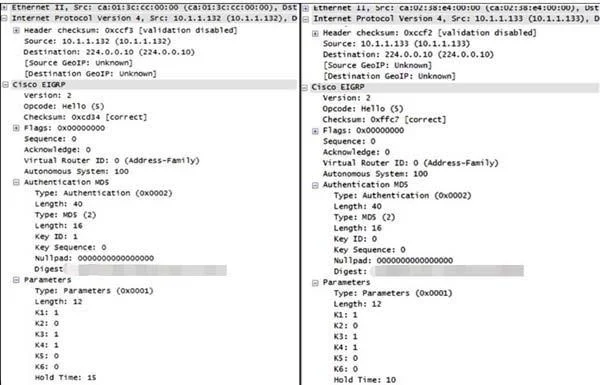
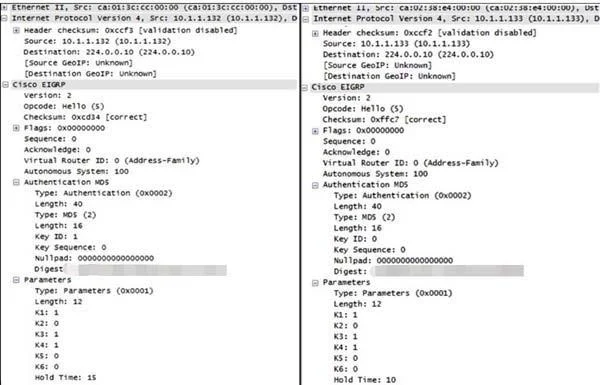
Refer to the exhibit. An engineer configures EIGRP but the routers fail to form a neighborship. What is the reason for the failure?
The correct answer is C. The key IDs do not match. EIGRP neighborship fails when authentication is configured because the key IDs on the two routers do not match, preventing successful MD5 authentication.
Question
Refer to the exhibit. An engineer configures EIGRP but the routers fail to form a neighborship. What is the reason for the failure?
Exhibits
Options
- AThe K-values are invalid
- BThe MD5 digests do not match.
- CThe key IDs do not match
- DThe hold timers do not match
How the community answered
(24 responses)- A17% (4)
- B4% (1)
- C67% (16)
- D13% (3)
Why each option
EIGRP neighborship fails when authentication is configured because the key IDs on the two routers do not match, preventing successful MD5 authentication.
Invalid K-values would prevent neighborship but are not the primary cause when authentication is misconfigured, as implied by the choices.
While MD5 digests not matching causes failure, the key ID mismatch is a more specific and fundamental authentication configuration error that would lead to a digest mismatch.
For EIGRP authentication to succeed, both the key ID and the key string (MD5 digest) must match between neighboring routers. If the key IDs do not match, the authentication process fails, and the EIGRP neighborship will not form.
EIGRP can form a neighborship even if hold timers do not match; the router with the shorter hold timer will simply declare the neighbor down sooner.
Concept tested: EIGRP authentication key ID mismatch
Source: https://www.cisco.com/c/en/us/td/docs/ios-xml/ios/iproute_eigrp/configuration/15-mt/ire-15-mt-book/ire-auth-eigrp.html
Topics
Community Discussion
No community discussion yet for this question.