
350-001 · Question #48
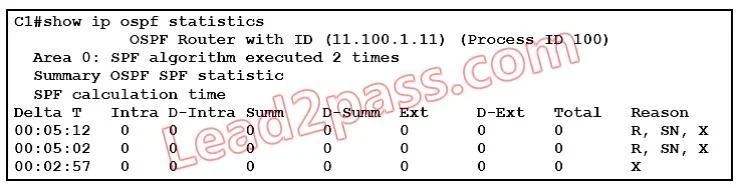
Refer to the exhibit. What triggered the first SPF recalculation?
The correct answer is B. changes in a router LSA, summary network LSA, and external LSA. Is built around links, and any IP prefix change in an area will trigger a full SPF. It advertises IP information in Router and Network LSAs. The routers thus, advertise both the IP prefix information (or the connected subnet information) and topology information in the same…
Question
Refer to the exhibit. What triggered the first SPF recalculation?
Exhibit
Options
- Achanges in a router LSA, subnet LSA, and external LSA
- Bchanges in a router LSA, summary network LSA, and external LSA
- Cchanges in a router LSA, summary network LSA, and summary ASBR LSA
- Dchanges in a router LSA, summary ASBR LSA, and external LSA
How the community answered
(45 responses)- A4% (2)
- B80% (36)
- C13% (6)
- D2% (1)
Explanation
Is built around links, and any IP prefix change in an area will trigger a full SPF. It advertises IP information in Router and Network LSAs. The routers thus, advertise both the IP prefix information (or the connected subnet information) and topology information in the same LSAs. This implies that if an IP address attached to an interface changes, OSPF routers would have to originate a Router LSA or a Network LSA, which btw also carries the topology information. This would trigger a full SPF on all routers in that area, since the same LSAs are flooded to convey topological change information. This can be an issue with an access router or the one sitting at the edge, since many stub links can change regularly. Only changes in interarea, external and NSSA routes result in partial SPF calculation (since type 3, 4, 5 and 7 LSAs only advertise IP prefix information) and thus IS-IS's PRC is more pervasive than OSPF's partial SPF. This difference allows IS-IS to be more tolerant of larger single area domains whereas OSPF forces hierarchical designs for relatively smaller networks. However with the route leaking from L2 to L1 incorporated into IS-IS the apparent motivation for keeping large single area domains too goes away. SPF is calculated in three phases. The first is the calculation of intra-area routes by building the shortest path tree for each attached area. The second phase calculates the inter-area routes by examining the summary LSAs and the last one examines the AS-External-LSAs to calculate the routes to the external destinations.
Topics
Community Discussion
No community discussion yet for this question.